
God bless Walter Hill for using the commercial success of 48 Hrs. to unleash Streets of Fire upon the world. Not that it’s necessarily great, or even the best version of its central idea, but this is the sort of “one for me” we should be celebrating. Streets of Fire plays like a feature-length MTV music video, a film engaged in the sonic hysterics and labile, melted-mutant editing of a post-modern pastiche of yesteryear’s rebellions. It’s like fading in and out of sleep to catch a stray fragment of a video for The Stray Cats after watching a rerun of a classic Western. Unremittingly brazen and mostly indifferent to internal characterization, it plays like the rougher and less fully formed sibling of Francis Ford Coppola’s One From the Heart, that director’s love letter to the fantasia of history’s dreams. Hill, who would have been sixteen when, say, Rebel Without a Cause was released, imagines a fever dream version of the memories that inspired him, here brought back to furious, warped life.
Not that Hill was new to teenage carnivalesque. His 1979 film, The Warriors, a nocturnal emanation of tough youthful romanticism and dingy luminosity barely held together by leather jackets and just enough masculine charisma to smother the future with. That film, based on Xenophon’s play Anabasis, understood that minimalist aesthetics could touch the suggestive void, that in its paradoxical milieu of abstract particularity, a film could snatch a fragment of the eternal. Hill often worked in this register: grainy and low-to-the-ground like a New Hollywood greaser, but teasing out the illusive and fantastic, the penumbra of abstraction around the direct darkness, either by marking his film as an allegory, as in the turbid and tangled waters of Southern Comfort, orby turning the characters into abstractions a la The Driver or in the meta-theoretical-generational The Long Riders. A Hill film is like its title: tight, iconic, even brutally clipped, yet somehow suggestive and oneiric.
Perhaps because of his straightforwardness, Hill was largely salvaged rather than savaged by the 1980s. Rather than overinflated budgets in search of transcendent, contemplative vistas, Hill was a guerrilla filmmaker, adopting relatively tight-and-tough inclination to shoot the damn thing and go home, Samuel Fuller style. But his films also survived into the ‘80s because of their abstraction, because of the paradoxical way they extract cosmic fantasies and ambitions out of bitter realities. A film like Streets of Fire is spartan and at times not actually as stylized as it pretends to be, but it is also an expressionistic, over-feeling dream story, one in which inner states seem to take on expressive corporealization in bodies that can’t quite contain them. His films reduce complex matters to bare minimums to discover what feelings seep out of cracks.
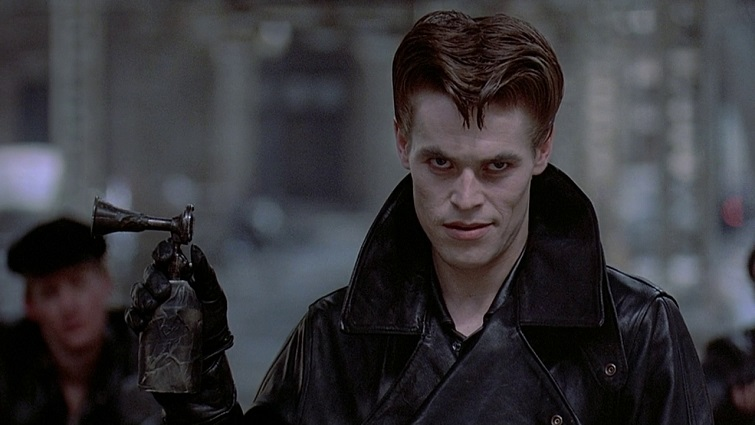
Case in point. The logline for Streets of Fire: man returns from war and assembles a ragtag crew to go to war to recover his girlfriend. Hill favors impromptu groups, often men on missions that were not their choosing, straight-to-the-numbers cinema films that mischievously emerge as cauldrons where personalities and types and teased and tested. He debases his films to elevate them, as anyone who has The Warriors well knows. The protagonists of Streets of Fire are also on a journey. When Tom Cody (Michael Paré) learns that his old flame Ellen Aim (Diane Lane) has been kidnapped by Raven (a deviously outré Willem Dafoe, who looks to be both 15 and 55, which is to say, a youthful imagination that can’t quite project itself into the clothing it wants to wear and a tired old dream clinging to youth), Tom hijacks Ellen’s new boyfriend and manager Billy Fish (Rick Moranis) and conscripts McCoy (Amy Madigan), a delicious amalgam of ‘30s tough-talking dame and Hawksian tough-women types, for the ride. The route they take is thoroughly unsurprising, nor is it intended to be anything else.
What matters, obviously, are the red-hot, hallucinatory compositions of cinematographer Andrew Laszlo and the rhythmic, off-balance editing of Freeman Davies. The ideas are simple and folkloric but vivid, and the texture is that of a film having a dream about itself. The film has an aloof, distant quality, like the characters are icon-types, or as though they’re play-acting their audition for the real deal. In switching and crossbreeding genres, Hill and co-writer Larry Gross conjure what could be called a pop-culture clusterfuck, a stray cat strut through a decade trapped in the memories of a generation before, unable to really to escape a bygone era as the end of history encroaches on them.
That’s not a unique observation of this film. Francis Ford Coppola, whose films did over-indulge their egos and their budgets and did very much play God, nonetheless excreted a truly sublime version of the same constellation of ideas just the year before in 1983’s mournful Rumble Fish. But that doesn’t stop Streets from its own strange alchemy of handed-down and exaggerated sensations. When Dafoe’s Raven walks forward in front of a fiery holocaust, he could be Christine, or The Terminator, a metal terrorist from a past’s imagined future. When he and Tom finally have their showdown, the film tries to achieve resolution via nobler means only to teasingly admit that this sort of justice doesn’t really work in the iron-clad prison of mythic-Hollywood archetypes. When they end up clashing with sledgehammers, by then fully fetishized as post-modern material extensions of a fluid sexuality, the whole world seems to stop for them, as though their mythopoetic masculine mano-a-mano conflict structures an entire world that can’t look away.
At times, one wants for more exploratory verve from Streets of Fire, which frankly remains too slim to fully commit to the bit, or to blow the bit to smithereens. Yet the film’s kineticism and channel-hopping charisma still wins. Frequently, the film indulges in a showy edit, and each feels like a toxic-waste wave we’re meant to ride into the next scene. They seem not only to move the story along or change genre but also to shudder the characters themselves, as though they’re so caught up in the molten energy of their performances that they can’t quite move between the scenes, or to stop to think how thin their characters are.
Streets of Fire feels like a ‘50s youth picture having a dream about itself, but it only clarifies its thematic priorities in the finale. Tom “gets the girl” and, like the cowboy wanderer of yesteryear, he has to leave to pave the way for the more “civilized” Billy he has allowed to exist. The film indulges in the potentially retrogressive metaphor, but then it cuts immediately to its closing music show (oh, by the way, this is a musical) for the deliriously melodramatic “Tonight is What it Means to Be So Young.” This is vintage Jim Steinman, who also wrote the opening number (“Nowhere Fast,” which could also describe the movie), a feverish, over-baked slab of clamped-down, libidinal energy. It’s really this spirit, one in which narrative corridors give way to pure-cinema explosions, that matters to the film. Tom must give way to a more liquid, more surrealistic music video medium, a (comparatively) new kid on the block, an arguably more reckless medium perhaps more receptive to the stray energies of modernity. Paré’s extremely square performance suddenly clarifies as something other than incompetence. He is an interloper on this progression doomed to move on to another story somewhere else, a wave-rider who knows when to get off, a cinematic hero propping up more interesting elements ready to have their time in the limelight. Plus, “Willem Dafoe and Lee Ving play two outcasts from a German Expressionist biker gang” is a sentence I need more of in my life.
Score: 8/10
 The Long Take
It’s a rock and roll fable… I love this movie.. I’ve watched it more times than I can count… 😍👍😎
LikeLike