
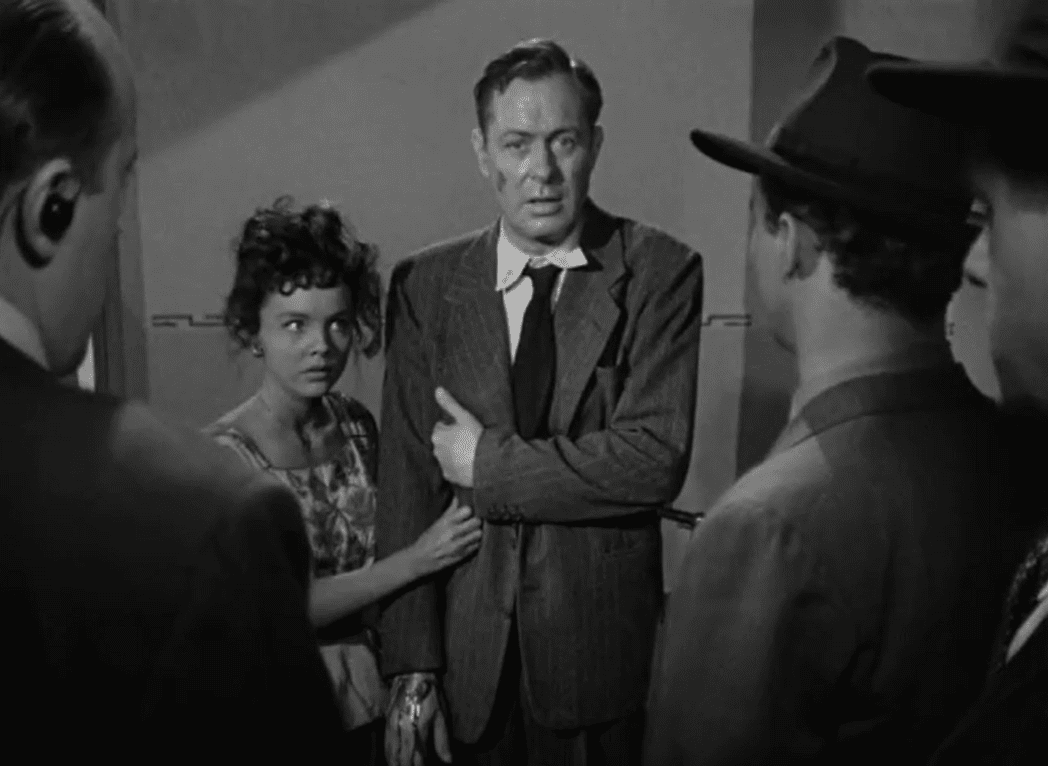
Ride the Pink Horse is a film noir about a man who travels to a small desert town at the border of the U.S. and Mexico only to find that he is vastly in over his head. The location is in no way incidental to the film’s vision. What we might call “desert noir” – films like Billy Wilder’s Ace in the Hole (1951) Edgar Ulmer’s Detour (1945), and (admittedly stretching the “noir” claim) John Huston’s The Treasure of the Sierra Madre (1948) – turns away from the noir’s typical haunting ground of the modern city to frame the desert as a limbo for wayward souls. While Old Hollywood Westerns often centered their moral universes around pioneering egos heroically exploring unseen frontiers, bringing light to the proverbial shadows, mid-century film noirs often shadowed the visible with intimations of vaster conspiracies and relations stringing humans along while slowly sucking them dry. To combine the two genres, to infest the Western with the blood of film noir, is to offer a curdled critique of America’s pretensions of access to possibility (monetary or otherwise) stolen from the land. Rather than celebrating divine effusion, these films bear witness to modern America’s demonic extraction, taking an outward violence and turning it back inward onto the soul. They turn the West that was perceived as a hinterland of possibility into a moral quagmire, one in which fantasies of Promethean overcoming within an unfashioned expanse come home to roost.
In this spirit, Robert Montgomery’s Ride the Pink Horse (1947) is a film about a man who is aspiring well beyond his means, travelling farther than he really can walk, to acquire something he doesn’t really understand. This was Montgomery’s second noir, a seeming step back from the bravura formal experimentation of his debut, a film shot entirely from the first-perspective of its protagonist that remains a watermark for the idea of the actor turned director. The protagonist of Lady in the Lake was none other than Raymond Chandler’s Philip Marlowe, the curdled noir hero par excellence, a figure evaporated but also oddly elevated and aggrandized by a camera that can’t even see him. The character is voiced by Montgomery himself, and not only are we trapped in his perspective, but he remains the film’s ultimate shadow. With Montgomery behind the director’s chair and the film directed by Marlowe’s own vision, entirely defined by where he looks, the protagonist becomes both a ghostly passenger in a narrative he can’t control and the ultimate director, a never-visible puppeteer behind the camera who can see literally everything we see.
Ride the Pink Horse isn’t as formally audacious, but it may, if anything, be more troubling, challenging, and sophisticated in the way it merges its style and its exploration of mid-century masculinity in the texture of its narrative. Montgomery again plays the protagonist here in addition to directing the film, and there’s a vestigial sense of the former film’s POV in the opaque angles Montgomery shoots himself from. Deemphasizing him in the space, the film draws us in to his limits, to his inability to center or command the frame that is supposed to legitimize his story. This is a thread that culminates in a deliriously thorny and self-debasing conclusion in which the nominal hero is rendered compliant and incapacitated before the villains. In a totally, defiantly egoless move on Montgomery’s part, he is saved at the last minute, through no skill of his own, by a man we aren’t meant to trust who talks and acts like a muppet.
The protagonist, incidentally, is Lucky Gagin (Montgomery), who ventures to San Pablo, New Mexico to blackmail Frank Hugo (Fred Clark) for reasons that don’t particularly matter to the film or to us. The questline is a classic MacGuffin that serves as the false center for the irreducible void of characters whose lives suddenly depend on an obscure object. Ben Hecht and Charles Lederer worked up a pungent script based on a potboiler written by Dorothy B. Hughes, more famous for In a Lonely Place, adapted as a savagely beautiful portrait of cosmic loneliness by Nicholas Ray for Humphrey Bogart. This is a looser and arguably more incomplete production than Ray’s film, but it also exudes a slippery creativity that invites revisitation. Itis a horizontal noir, in that it explores a collective of types for a few days rather than following them to the cataclysmic conclusions of their lives. It is also a vertical noir, in that rather than moving forward along a narrative line, it constructs and elaborates a paradoxical mood of unworried apprehension and then moves up and down that tension cord to explore various permutations of it.
Along the way, we meet the good-natured Pancho (Thomas Gomez), who operates a carousel like he was born to do it, young Native American Pila (Wanda Hendrix), who probably shouldn’t get involved in Lucky’s story, the mousey, Harry Truman-esque Ret (Art Smith), an apparent government agent who, in this kind of film, could work for any of a dozen organizations, and Marjorie (Andrea King), a femme fatale who has an elusive relationship to both Lucky and Hugo himself. These people are all ill-at-ease with the story they move through, and the film is mostly unsure of how they should move through it. No one quite fits, but everyone slides into place, as though they’ve accepted their lot in life. We get the sense that they are doomed, that they will always end up in a situation like this unless – or even if – they choose to act differently. Yet the film seems unsure not only of who we should trust, a more conventional noir skepticism, but also whether we or they should care about any of this, a deeper doubt. Whether we are supposed to be rushing or lounging, and toward what, and why toward that what, remain in delirious flux throughout a film that seems to ponder if the protagonist saving his soul would be a genuine victory or simply one more turn around the cosmic carousel back to the same gutter.
A moral circle the film literalizes in its most bravura shot, and the basis for its marvelously opaque title: a pulverized Lucky slumps over in a carousel seat, riding the pink horse while hiding from some pursuers, and the camera stays in place with him for a circular ride, the camera catching a new glimpse of Pancho being savagely interrogated and beaten each time it goes around. While this scene begins with an already brutalized Lucky, the moral center is certainly Pancho, who redeems the possibility of human connection and a mode of relation not predicated on or conscripted to self-gain. Each time the camera goes around, we get a sense of another life we are only momentarily privy to, but one that nonetheless seems willing to sacrifice all for a man he just met. Montgomery, meanwhile, is admirably parsimonious with his own weathered mug throughout, shooting him as a background figure not traversing an environment boldly but standing at odds with it. Pancho’s story, we’re made to wonder, may be the more worthwhile tale after-all.
Throughout, Montgomery’s camera is especially adept at turning the turbid waters of noir into a series of volatile visual frissons that connect the characters, and clarify the relationships, in unexpected ways. But I, for one, couldn’t stop thinking about Fred Clark’s oily, vaguely dangerous antagonist, a rancorous and slimy operator who at one point faces the receiving end of a clever graphic match that equates and contrasts him with the God of Luck Zozobra. That he is constantly fingering with his metallic hearing aid isn’t, I think, an indicator of a man who is villainous because he is part machine but, rather, a marker of a society dealing with new, potentially life-saving, technologies that it can’t fully control.
I refuse to believe that this portrayal of Hugo wasn’t the inspiration for another directorial self-portrayal: David Lynch’s Gordon Cole in Twin Peaks, who talks in the same agitated smack and also wields his hearing aid like an irritant whose target switches by the minute. The beguiling episode 8 of David Lynch’s Twin Peaks: The Return is perhaps the ultimate desert noir. If mid-century scientists framed themselves as extensions of the Western spirit, cosmic cowboys slowly replacing the unknown with the known, Lynch frames Robert Oppenheimer’s Trinity Test as sublime horror truly beyond visual comprehension, a portrait of humanity having unleashed hell on earth that renders any conventional narrative form pitifully incapable of reckoning with it. When technology becomes severed from morality, Lynch suggests, we lose our capacity for art to bear witness to terror, to ground ourselves in the world, even to represent the consequences of our own doing.
When Lucky gets off the bus at the beginning of the film, he saunters to the right and into a bus station, and the camera apprehensively sidles up to him and trails behind. The very camera that is supposed to authenticate his prowess and masculine journey instead queasily sizes him up as he wanders around and deeply unaware of where to go. This is no assured, intrepid traveler elegantly mastering a new space, but, rather, a dangerous and confused nobody trying to make a name for himself in an area he feels is less restricted, less conquered, less regulated, an ostensible frontier and thus an apparent moral gray zone he assumes he can manipulate to his liking. Ride the Pink Horse, you get the sense, is growing progressively more aware of the violence of expansion that Lynch depicts the fallout of. The film can’t admit it except in its quiet nervousness, its inability to dwell on the limits of the instability it is nonetheless constantly catching whispers of. When Lucky steps back outside the bus station, it’s not just that his luck may be running out, but that humanity may be on a circular carousel of destruction it has no way out of.
Score: 8.5/10
 The Long Take