
Update: I did not know at the time of posting this review that Roger Corman had passed the day before at the age of 98. Although any review of a positive object is always intended as a tribute to its creators, I hope that this piece provides, in however minuscule and unformed a way, a eulogy for Corman and a celebration of the spirit of wry, unadorned, knowing simplicity and disobedient innovativeness he represented. RIP
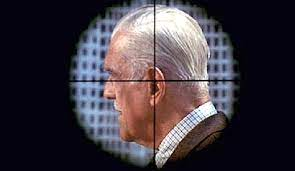
The first time we meet Bobby Thompson (Tim O’Kelly), the protagonist of Peter Bogdanovich’s debut directorial film, it’s from his own line of sight. The film takes his perspective, the camera through his gun-scope, aiming at aged movie actor Byron Orlok (Boris Karloff). The gun store owner selling Thompson the rifle comments on being in the vicinity of the faded star with the enthusiasm of a fan vaguely amused at realizing he actually exists in the same time as a dim memory of yesteryear. Thompson, though, has already clocked him, another old haunt down the scopes of a new generation of (extra)cinematic terror.
There’s no two ways about the cinematic subtext, and no way to miss it. It is thoroughly apparent that Bogdanovich studied Peeping Tom as well as the next guy, and he understood Rear Window in more or less the same way many of the young scholars of his generation did. Like those critics and scholars, Bogdanovich was reborn in the first film school generation, when an increasing fascination among young filmmakers with the history of cinema itself took hold. He also shared with the mid-century French film critics an intrigue about workaday American types and journeyman filmmakers like Anthony Mann and Howard Hawks, figures able to keep their perspectives dimly alive in the belly of the beast. This was the same spirit of personality within machinery, of adapting and allowing oneself to be adapted, which many of the new American directors would fascinatingly and beautifully lose by the end of the 1970s as their films got bigger, bolder, and more unrestrained. Like many of these fellow upstart filmmakers, all trying to figure out how to penetrate the Hollywood studios with their self-reflexive knowledge of film history, Bogdanovich also got his start in cheap, grimy independent pictures, worms feeding on and wriggling new life out of the decaying carcass of Old Hollywood. Targets, which emblematizes this meeting of high and low brow, of conceptual rigidity and corporeal immediacy, is suffused with cinema on many levels, and by the film’s end, cinema will have its way with Targets.
Bogdanovich’s film itself includes a loving Hawks tribute in referencing 1931’s The Criminal Code, one of Karloff’s earliest vehicles, an indication of the tradition the film wishes to claim its place in, and throughout Targets, Bogdanovich does indeed evidence a Hawksian interest in minutiae, a tinker’s eye for everyday deconstruction. Take the silent scene where Thompson, a young, deeply disturbed Vietnam veteran, quietly, boyishly climbs up atop an oil rig on the side of a highway and sets out several rifles like toy guns, before pleasingly pulling out a coke and a sandwich, a parody of everyday domesticity, as though he’s just setting up for another day at work. A shot of Thompson looking down the scope, taking off the cover of the focus dial, and then adjusting it, clarifies something about his methodical, workmanlike disposition. It also embodies Bogdanovich’s eye for the everyday mechanics of life influencing the casual cruelty of extreme circumstances, a suggestion Bogdanovich then fulfills with his unscored, documentary-like sequence of Thompson mowing down passing civilians. There’s no logic or explanation to any of this. Visualizing it directly, without embellishment, the film suggests, explains itself, makes horror singularly tangible in its opaque inexplicability.
When Thompson stings himself on the gun mid-sequence, the film suggests a journeyman filmmaker trying on a tool of great potential destruction and not capable of fully considering the violence he is about to commit. By film’s end, Targets will underscore the gun-camera connection with shots of a projectionist slowly setting up for a drive-in film-screening of Corman’s 1963 film The Terror, starring a young Jack Nicholson and Karloff himself, potentially unleashing something unspeakably terrible upon the world. Targets is intrigued by, and not entirely settled on, both the differences and the similarities between the filmmaker and the shooter, between cinematic and real horror. The first half of the film parallels various kinds of artificially-lit, deliberately-constructed interiors, both the formalized Hollywood offices and apartments Orlok haunts and the manicured suburban domesticity Thompson uneasily strays through, with the same deconstructionist’s eye for the set-designed nature of mid-century American life. Here, setting up a murder is not so different from conjuring a film set. When the style shifts to a more “realistic” perspective later, silently examining the wide vistas of modern Los Angeles with documentary detachment, Bogdanovich promises a newer form of violence that is more authentic, more omnipresent and yet more capillary, more devastating yet more quotidian, simultaneously able to escape cinema’s capacity to render it and to invite cinema to pursue new forms of visualization in the quest to lay claim to it. Yet by the film’s end, even these newer forms of violence seem just as embedded in various modes of stylization (just as constructed) and just as monotonous (just as routine). What really separates new from old remains opaque.
Still, the film, in an act of slight self-hypostatization, clearly imagines itself here as a pivot point in a long-form cinematic arc, an elliptical premonition of things to come. Bogdanovich is obsessed over cinema’s past here, but he imagines its future, a dispatch from the end of late 1960s social unrest, and a challenge that Robert Altman would meet with the finale of Nashville and David Cronenberg with preternatural psychic second sight in The Dead Zone. Bogdanovich himself had worked under Roger Corman, who gave a generation of upstart American directors their first start and offered the American genre picture they so loved a second lease on life. Nicholson, on-screen in The Terror (and thus in the climax of Targets), would go on to work with the likes of Bob Rafelson to produce portents of nation more publicly reckoning with its own waywardness, a violence come to roost, as he developed a cynical, angry young man persona that would take him to the limits of his nerves by the time Stanley Kubrick got ahold of him in 1980.
And then there’s Karloff, the star who made his career playing heavies but arguably never contoured so stone-faced a visage as Orlok’s. Famous for playing the cinematic embodiment of Mary Shelley’s vision of Enlightenment rationality run amuck, a cracked-mirror image of the new man, he was now in his early ‘80s, taking the guise of an icon figure in Bogdanovich’s lament for the cinematic lost. Weathered and weary but deeply dignified, hisevery word is a severe, unsmiling description, a dark transmission from an earlier time that doubles as a warning for his, and a kind of humanist plea for the possibilities of connection dimly visible beneath the terror. He makes claims upon us that are irreducible to the last years of a single life, asking us to ponder the value of one final shot at one’s craft, one final, authentic connection with those who we bring joy to, even as the film inevitably suggests these are dwindling propositions in the modern world.
Targets is a thoughtful, textured film, but it as much an essay about older films as a living, breathing exemplar of a new breed of cinema. It is both too stiff and theoretical to sit next to, say, Peeping Tom and too nervy to write off entirely, more like a sketch of an essay, a film that is simultaneously formalizing and deforming itself with every new shot. If it is arguably a superior essay about cinema than it is a remarkable film, this very tension both keeps it from fully feeling out all of its ideas in its crosshairs and allows it to scour the corners of the frame for more knives pricking the cadaver of Old Hollywood. Case in point: a late-film, drive-in screening of Corman’s The Terror where Thompson makes his final stand is both an intensely theoretical set-piece, obviously designed as the summation of a thesis statement, and a spirited, ever-so-slightly silly attempt to push cinema in a more curdled direction. Thompson himself uses the screen as both a shield and a sword, sticking his gun out of a hole near the screen so he can point his rifle at the unsuspecting viewers and remain masked by the shifting colors of violence projected before our eyes, as though Old Hollywood cinema – our definition of horror – is keeping us from recognizing something lurking right under our noses. It’s extremely on-the-nose, and maybe to clever by half, but it still has real bite.
The new breed of violence, the film thus implies, utilizes but also penetrates beyond the spirit of the old. Classical Hollywood protects it but cannot contain it. On one hand, Bogdanovich shoots the gun like a camera out of a projectionist’s booth, the sniper rifle pointing down with the revelatory gloom its wielder may feel marks him as the beacon of a new, cleansing terror. Yet it is the projectionist’s booth, a genuine beacon of cinema, which is actually pointing at the gun, bathing it in red light, covering up its dormant violence even as it seems to call the violence out. The film’s climax ultimately attempts to mitigate this tension by having Karloff as Orlok march toward Thompson in-step with his character in the film-within-a-film, confusing and disarming the boy as Karloff remarks, seeing Thompson cowering like another cinematic creature, Count Orlock, in the shadows, “is that what I was afraid of?” It’s an ambivalent but hopeful ending, one that posits that Hollywood’s specter still has potency, is a genuine weapon against the horrors of reality, providing a means of subterfuge greater than the real world can. Cinema and reality harmonize to disarm a form of violence that initially seems pitilessly beyond cinema’s purview.
If this provides a salve, the film still stings. Throughout this final sequence, Thompson himself is positioned high-up amidst the belly of the screen mechanism, an industrial womb that allows him to figuratively meld with Hollywood horror as he unleashes it. The final shot is the subsequent morning, the empty parking lot of the drive-in with only Thompson’s car remaining, a marker of a world he no longer feels comfortable in, and an omen of a violence that cinema may be incapable of reckoning with even as the filmmaker shoots it with devastating straightforwardness.
Score: 8/10
 The Long Take