
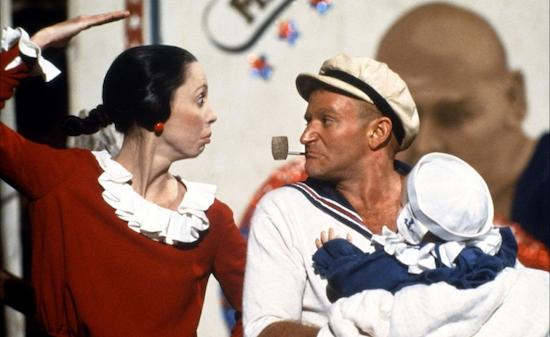
Whatever may or may not be true about the demise of the New Hollywood in the late ‘70s and early ‘80s, the story practically writes itself, and it certainly helps spice up the films. Michael Cimino’s oneiric Heaven’s Gate, Francis Ford Coppola’s dementedly luxuriant Apocalypse Now and his heartfelt, slovenly One from the Heart, and, of course Robert Altman’s own Quintet and Popeye all went grossly over-budget and wear their exaggerated passions on their sleeves. But, unlike the others, Popeye was nominally intended as populist entertainment! And it is as thoroughly scatter-brained and bedeviling and dumbfounding as any last one of them, a truly suis generis slice of creative hack-work, as perplexing as the crystal Mrs. Miller looks at, searching for an impossible answer to America’s riddles at the end of Altman’s masterpiece McCabe & Mrs. Miller. Much like Coppola’s One from the Heart, it is fundamentally about Great Depression popular cultural, and like One form the Heart, it is absolutely deranged. As with Coppola’s film, it went colossally over-budget producing a set that it could not possibly justify (and yet does!) that was constructed, in Altman’s case, on location seemingly with the intent of evoking a soundstage. Or to serve as Altman’s backdrop for a production-length coke party. From Shelley Duvall’s note-perfect, almost impossibly serendipitous performance as Olive Oyl, to Robin William’s dangerously committed, deliberately alienating turn as the titular outsider who genuinely seems to occupy a different world from everyone else in the film – and because the film is so thoroughly estranging, therefore the same world – this is an absolutely uncompromising dispatch from another cinematic world. It is so feverishly committed to its own disturbed wavelength that it feels like it could have been directed by John Boorman, although probably without the Sean Connery nut-slings.
Still, it’s an Altman film, through and through. Many of Altman’s films were, in one way or another, a dissection of how America related to its own visual and aural iconography, finding (at times accidental) truth in fiction. Popeye, at the time chastised as Altman selling out to the pop cultural lexicon he so often dissected, explicitly tackles a recycled consumer property by name, and under the belly of the Hollywood studio system. Opening on a shot of the animated Popeye, black-and-white, speaking directly to the camera, informing us that he’s “in the wrong movie,” the film smash-cuts to a stormy seaside town as “A Robert Altman Film” appears overhead, usurping the titular character’s authority with a decidedly different breed of central figure. Popeye initiates itself by dissociating itself from the fiction audiences might expect, already foregrounding disharmony and hinting at the difficulty, even the incomprehensibility and delirious idiocy, of making a live-action adaptation of E.C. Segar’s comic franchise and the Fleischer Studios animated cartoons at the end of the 1970s. The introduction is a direct descendant of Altman’s Brewster McCloud, where the iconographic MGM lion roars with the audio replaced by René Auberjonois’s “I forgot the opening line,” another confrontational fiction-breaking abnormality and a promise on Altman’s behalf that the story we expect has been distorted and defanged.
Although, frankly, Popeye’s real antecedent is McCabe, Altman’s elegiacally mournful masterpiece which Popeye covers in comically rambunctious fashion. It similarly relies on the classical Western narrative, where a hero enters a town to save the day at just the right moment. While McCabe melancholically ironizes the classical Western, Popeye brazenly travesties it. The film explicitly plays on its own artificial nature and deconstructs not only the circumstantial nature of the character’s arrival but the visual iconography of the hero. Popeye, for instance,is introduced in a perilously wide shot early on, dwarfed by the threatening water, with silhouetted objects in the foreground blocking our view of him. This image, our introduction to this film’s “live action”, in turn denies the “live action” Popeye the expected honor of a magnificent introduction (a la McCabe’s famously undercutting glimpses of its ostensible protagonist). Contrast this with, for instance, the booming, bellicose, monolithic zoom to John Wayne in Stagecoach where Wayne overtakes and masters the landscape almost immediately. In Popeye, the landscape has bested Popeye right from the start, rendering him almost invisible.
The magic of cinema will soon, of course, transform social outcast into town savior. Its narrative logic is predicated on it. Yet, Altman reminds us, his formal logic most certainly isn’t. When a fight breaks out, the narrative and the camera can’t agree on who wins. During the bout, a man to Popeye’s right attempts to hit him with a chair, which becomes lodged in a ceiling fan blade above Popeye. After the fight, the camera cuts to a wide shot, Popeye’s victims strewn about him with Popeye in assumptive victory. The camera is positioned above him, rendering him diminutive and helpless, but also capturing the ceiling fan, having begun turning due to the chair lodged in it, visually overtake Popeye’s body as if one of the blades is decapitating him. Even the film’s ostensibly comic slapstick is warped and rendered visually violent via the film’s blocking and framing, and Altman’s vigorous insistence on foregrounding everyday objects that deny the action of the film its assumptive catharsis. Narratively, Popeye has won the bout, but he walks away to a cut of him in front of a cross-hatch of iron clad bars, the camera on the other side. He is technically free to go, but the editing asks where to, and what freedom and hero-ship really mean. Here and elsewhere the film is torn between its existence as post-Star Was cinematic entertainment and Altman-esque critique of fiction as entertainment, deconstructing the very notion of hero success even as it endorses it.
Popeye is fascinatingly at-odds with itself. Tensions percolate between the film’s sharp-edged, cluttered mise-en-scène and its somewhat gentle pace, between its densely layered, even lush sound design and its hard-of-hearing demeanor, its status as a “musical” and its reluctance to indulge in obvious melodies, and in its shambling, almost anti-narrative episodism that belies its last-gasp rush to a comically, possibly intentionally, unsatisfying conclusion. In this light, the film’s more overt slapstick touches (the noise of the punching bag, a later scene where villain Bluto squishes a person) appear less cartoonish and more venomous, as if human geometry and flesh has been distorted before our very eyes. And the general zest for cartoonish chaos can’t squash the generally forlorn texture of the film. Even the sharpest splotches of color, nearly always American reds, whites, and blues, typically feel like teasing reminders of the fallaciousness of optimistic vistas rather than honest markers of domesticated hope. For an increasingly cynical 1970s, the thin veneer of Americana (also epitomized by the American flag carted around by the villainous tax collector, who even taxes the quest for knowledge) scratching at the film from the margins hints at a lingering doubt in the ability of Americana and its imagery to meaningfully protect the sanity of the film’s main characters, as well as the audiences’.
It’s also quite a disconcerting musical to boot. The opening number is choreographed to the townsfolk gauntly stunting forward into the frame like pallbearers, hardly an image of good cheer. The other musical numbers are drowsy affairs that emphasize simplistic non-lyrics, negative emotions, and almost-spoken, barely-sung half-melodies, tacitly undermining the joie de vivre the musical form promises but may no longer be able to authenticate. Popeye’s sound design also contradicts and even sabotages a number of the songs, recasting Robert Altman’s typically decentralized, diffuse audio-scape as a critic of the very idea of a Hollywood musical. The deflated, almost passive nature of the songs are often drowned out by sometimes indecipherable noise. Other instances of audio sabotage abound, such as a rattler snake that is, in fact, a baby rattle, a witty instance of audiovisual irony that confuses domestic safety and feral danger, reaffirming Altman’s commitment to a world in which traditional markers of safety have been distorted beyond recognition.
And, of course, Popeye’s mumbling speech is an obvious fit for the famous folds of Altman’s communal audio chatter. In the aforementioned bar scene, Popeye discusses his hope to find his father with another town patron, Wimpy, but the camera intercuts between close-ups of Popeye speaking, almost unintelligibly, and wide shots positioned from the other end of the bar, behind a gang of onlookers positioned like an audience, themselves struggling to listen to Popeye, who is continually disrupted by the much louder commune of the bar (Popeye even turns around, flustered by his own inability to hear himself). The meandering narrative, which seems to avoid Popeye’s story and occasionally wander into the “right” beat as if by chance, sequesters all of Popeye’s “heroic” moments, such as a boxing match, into single scenes set off from the rest of the film. Typically Altman-esque, the film seems actively unsure of Popeye’s status as savior, fraying rather than clarifying the mythic hero’s purported capacity to resolve a town like Sweethaven, or a nation like America, into a facsimile of order and sanity yet again. (Wolf Kroeger’s production design is a glorious Frankenstein of Americana that comically unmoors various time-periods from their contexts.)
Popeye’s mumbling verbal incoherence mimics McCabe’s discordant, rambling, self-distorting dialogue in McCabe & Mrs. Miller, and indeed, the extent to which Popeye does not understand the town of Sweethaven, as well as the extent to which we the audience cannot understand him, even to the end when he tries to disown the town for its gambling nature, tend to be mocked rather than celebrated by the film. Popeye himself is often presented as a strange, befuddling question for the film to peruse rather than a hero to save the day and whip the film into shape. From the very beginning, we are denied Popeye’s perspective of the town. Altman’s style favors perspective shots from other characters, including the villain (Paul L. Smith’s Bluto) and ostensibly incompetent sidekick Wimpy (Paul Dooley) while Popeye himself is visually denied throughout, not granted the agency of a central visual perspective. In an early sequence where Popeye arrives in town, we cut from a shot from Wimpy’s perspective looking through an eyeglass directly at Popeye, while a similar sequence of Popeye looking through an eyeglass is presented with the camera hidden behind fence boards starring over them at Popeye, looking at us as we adopt a lurker’s perspective. In yet another, when looking through a hole in a door, we confront an ominous eye soon revealed to be Popeye’s own. We do not adopt the perspective of or the sympathy for the noble Popeye looking in on the town to better it, but the skeptical town questioning Popeye as an almost fictional construct of arbitrary goodness we must interrogate, a Hollywood vision of salvation we might doubt.
Here, more than anywhere, Popeye remains very much an Altman movie, one that positions itself between the populist cinema of the late ’70s/early ’80s and the auteurism of the American New Wave during the early ’70s. Ultimately, Popeye reflects the tumult of a decade where physical and aural space almost seemed conspiratorial in their rejection of safety and sanity, where popular media increasingly questioned whether popular culture was actually a safe haven or respite from a cold world. Popeye reflects a world in which the very fiction Hollywood turned to for escape bites back at itself, questioning its own structural and visual integrity, and like the world that created it, its own sanity. The town feels precarious. The one genuinely collective song is barely decipherable (shades of Nashville). The choreography, both walking and dancing, emphasizes fumbling bodies and flummoxed legs. In a very real sense, the characters occupy the same world as many other Altman films, where an action-and-reaction narrative that favors catharsis and audience gratification is intentionally withheld. In this light, Sweethaven, a locale where individuals are in search of a goal that never finds them, suggests an entertainment enterprise on the edge of its capacity to fulfill its mission, and a nation having lost any pretensions of its.
Score: 10/10
 The Long Take