
After spending the better part of a decade running riot with the works of Edgar Allen Poe, H.P. Lovecraft’s chthonic short stories seemed like the obvious next step for American International Pictures, another textual canvas to scrawl on and fascinatingly deface. Unsurprisingly for any connoisseur of low-brow, high-aspiration mid-century horror, this is a decidedly untethered adaptation of Lovecraft (which befits AIP’s extremely loose orientation toward Poe as well). Rather than a paean to celebrate or altar to worship, Daniel Haller’s The Dunwich Horror appropriately figures the author as a portal to channel or an opening to explore, a cosmic constellation of images and suggestions to tease out rather than submit to.
Haller’s film opens with a kind of precis for the texture of the whole film: a tableau of static figures locked in time, a fully ordered, barely moving presence, that is nonetheless cut up and disfigured by the editing, never fully clarifying into a clear vision or a pierceable image, something at once obvious and misleading, manifest yet ephemeral. The scene seems to give us everything and nothing: a woman seems about to give birth to a demonic entity, marking this as a Rosemary’s Baby pastiche, but the bit ends before we can fully grasp it. In this tension, The Dunwich Horror disorients itself but also finds a mode of expressing its theme, a battle between order and chaos in which the delineation between the two may not be so easy to divine, and the forces of societal control may not be what they seem.
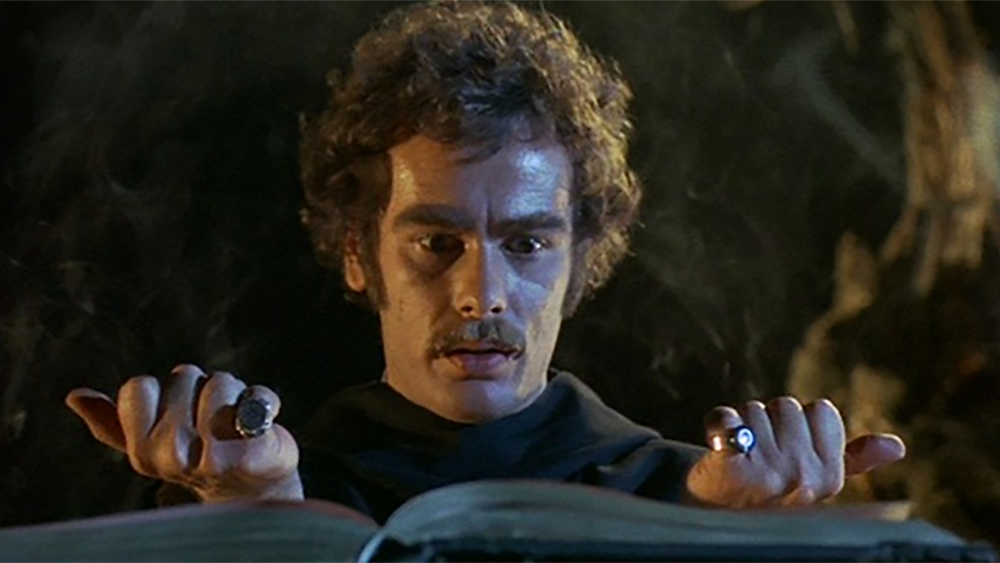
One such liminal figure, a man who dresses like an Old Money bastion of a fading order and a sly conduit of other orders outside our world entirely, is Wilbur Whateley (Deam Stockwell) , who enters the film approaching Dr. Henry Armitage (Ed Begley) about the Necronomicon, a book that doubles as a portal to the netherworld that even the professor wields with insouciant ease. Simultaneously stone-faced and shifty, Stockwell underplays him with an otherworldly gloom, wielding dialogue like we’re “just like everyone else, they’re just more honest about it” as though they were meant more for himself than us or the other characters. Playing less to material world than some metaphysical truth working within the boundaries of his soul, his eyes skitter about the frame in search of a grounding rod or a target, an uncertain portent in a seemingly strait-laced frame.
But it’s college student Nancy Wagner (Sandra Dee) he has eyes on, grooming her as a gateway for the return of Yog-Sothoth, one of Lovecraft’s elder-gods we are doomed and blessed to be unable to comprehend. Lovecraft, we now know, was also tormented and fascinated by the currents of social resistance in his world – racial strife, proletarian revolt, anti-colonial resistance, industrial growth – he considered vexing presences beyond his own comprehension. In many ways, his stories reflected his inability, or unwillingness, to fully analyze those social forces, his fundamentally conservative world order that couldn’t completely refuse that which it couldn’t entirely admit. This very 1970 filmfinds resonances between Lovecraft’s own obvious fears about repressed and untamed worldly forces and its own unstated other, the late ‘60s psychedelia that only appears in this film as a momentary flash of another world attempting to peer in. In momentary shocks, the film nearly seems to break apart as its own unclarified forces, psychedelic art and hippie cults, reject their own marginalization. They invade a film that seems both fascinated with and unable to truly explain or think with them.
That, of course, means that most of the film is somewhat cautious and orthodox, that its most stylistically audacious experiments are doomed to remain temporary dispatches from another, perhaps more daring film. The film’s limits, then, can only be its strengths, and vice-versa. Director Daniel Haller was a set designer on some of the AIP Poe films, and it shows in the unearthly colors that populate Whateley’s house early in Dunwich, splashes of otherworldly radiance that offset the mostly naturalistic color palate of the surrounding environs. Haller’s directing, for the most part, is often less compelling, suffering from a stagebound formality. It’s all a bit staid and overly composed, but, when the film momentarily erupts into orgiastic displays of cosmic love or technicolor shocks of kinetic, plasmatic color, it’s as though The Dunwich Horror is breaching its own limits, exploring beyond its own horizon of possibility.
Finally, the contrast between the hidebound classicism of most of the film and the tampering, mystical visions that haunt it with the possibility of something more appealing, more unterrified, more experimental, suggest the tension at the very core of the film’s narrative, of something repressing and something demanding to be unleashed. It’s as though the film is only temporarily able to reach the levels of insight that Whateley so desperately craves, and Haller can only dramatize our own failures to do so. Art, the film finally suggests, is an opening to another dimension, but the necessary difficulties of artistic conjuration – the very friction of composition and formalization, the violence Richard C. Glouner’s cinematography and Christopher Holmes’ editing do to the anarchic currents of reality by solidifying them into a finished text – threaten the very stability of this revelation. Thus, when the film’s actual monster is “unleashed” into this dimension and a posse of townsfolk attempt to track it down, rather than a direct horrifying image of the beast, we only confront its traces: heaving suggestions of a windswept force rushing down a road and POV shots visualized as abstract film negatives. The film is unable to represent the monster straightforwardly, which seems both beyond its capacity and necessarily a threat to both the characters and to us, the viewers. The forces of order, the film viewers included, are hunting for a glimpse of the monster, but the film itself is hunting us back.
Score: 7/10
 The Long Take