
Rumble Fish is plainly the product of a director who had been bruised and humbled. After producing at least four genuine cinematic classics during the 1970s, the near-death experience of making Apocalypse Now, an exercise in cinematic self-flagellation that wanted nothing less than to both channel and contest the very warp and woof of the world,did nothing to quiet Coppola’s ego, which went on to just barely stabilize the remarkable, unfeasible, impossible flop One from the Heart. Reigned in but not daunted, Coppola looked to the aspirations and dreams of his children to make a pair of S.E. Hinton adaptation The Outsiders, which certainly conjured images of his own youthful days. The evocative but nonetheless straightforward The Outsiders was Coppola on guard, proof that he could – for the moment – play ball. But Rumble Fish, his second Hinton adaptation in the span of a few months, was something else entirely. Forced to domesticate himself, to play house with the corporations, he became a termite, gnawing away at the wood from the inside. Working as a director-for-hire turned into a secret, sideways passion project, a buckling of the man’s Ahab-like desire to conquer the cinematic machine becoming a quieter rebellion, a tacit conspiracy with the machine itself. Rumble Fish reaffirms that art, even swallowed by the very belly of the beast it once tried to destroy, cannot be killed.
Still, Coppola was no longer trying to collapse the cinematic edifice from within, or to engorge it to the point of explosion. He just wanted a better feel for the grain, to see what new textures Hollywood might bear if construed as a wandering canvas, one to explore humbly and feel-out earnestly. What people in the industry call “director jail” became, for Coppola as for Robert Altman, an opportunity to refashion his very core, to sacrifice his ego and produce a no less daring work on a more human scale than the psychic abandon of Apocalypse Now or the cosmic carnival of One from the Heart. Rumble Fish has all of Coppola’s demented cinematic energy without any of the portentous ego, all of Apocalypse Now’s inchoate exploration and otherworldly fragility without its crystalline brutality and tyrannical splendor. Rather than trying to control and destroy us on his own war-path of violent cinematic transcendence, Rumble Fish is a film that turns simplicity into diffidence and a lack of identity into an identity all its own.
This film is not the result of a director with something to prove but a man genuinely trying to figure something out, to tease out the emotional and mental rhythms of a certain headspace of stunted growth, of someone who thinks he’s a lion trapped in the position of a housecat. That being the brain of one Rusty James (Kevin Dillon), who isn’t so much a protagonist as a floating body for the film to wander with and around, as he vibrates waywardly. Until, that is, his older brother Motorcycle Boy (Mickey Rourke) returns from California. Rusty James is clearly infatuated with him, or the idea of him, as an aspiring image and desiring object of his James Dean fantasies as the characters engage in idling longueurs, make and casually break plans, and ponder without really working through their problems. These are teenagers desperately in search of the kind of personal authenticity that so often comes from naming oneself while really wearing the costume of others. The film, similarly, is a delicate constellation of scenes and suggestions from other films masking as a unique object, a mosaic of cinematic hand-me-downs in search of a style worthy of the name, a film that seems deeply aware – perhaps as aware as these kids – that its quest for originality and newness is a ruse, that the craving for stylistic rebellion, theirs or Coppola’s, is a double-edged sword.
Given that this film was, at some level, an exploration with his children’s recent passions, it’s amazing how self-evidently it isn’t interested in pandering to them, or even being for them really. But it is about them. Rather than making a film they would want to watch, Coppola seems to have found in youthful desire an impressionistic canvas for themes and textures, moods and milieus, stray sensations and barely-understood possibilities, an ode to the messy headspace of youth that doubles as an ambivalent statement about the possibilities of creativity within a system that swirls your headspace with references and rhythms that don’t always cohere together. The film opens with a near-direct riff on Koyaanisqatsi, a visual of reversed clouds which Coppola probably just thought was a cool visual. But there’s something honest about the way it tries on and mixes so many textures without quite having digested any of them individually, as though the film is so caught up in the surface textures of youth that it understands their superficiality not as a failure of imagination or clarity but an omnivorous foraging that might be totally ok with drifting between textures without feeling the need to fully grasp them. The film both is and is about the sense of quivering with feelings one can’t quite express, and leaping between attempts to try, turning the scavenged carcasses of other cultural sources into a canvas of quiet but wounded possibility.
That is perhaps the easiest way to parse Rumble Fish, all frayed cinematic ends and torn patches pickpocketed from other, seemingly incompatible directors. Nicolas Ray never hovers far away, but we don’t only get Rebel Without a Cause’s dreamy clairvoyance and frustrated impudence. Bigger Than Life’s delirious portrait of febrile suburbia is here too. Elsewhere, a sensual classroom dreamscape sideswipes Kenneth Anger’s demonic carnivals of mid-century masculinity. More broadly, Coppola’s film suggests West Side Story, Umbrellas of Cherbourg, and Breathless in equal measure, a film about both infatuated with and confused by the films around them that is itself obsessed with and unsure about the films its director grew up on. It’s an assemblage of what one character calls “all that shit you see in the movies, man”.
But make no mistake, either in spite of or because of its many influences, this is truly a work resonating to its own rhythms. While it occasionally evokes the baroque aria of the Godfather movies and The Conversation’s gnarly vision of a world totally askew, little in Coppola’s oeuvre even glimpses at the peculiar vibe evident here. Coppola has stated an expressionistic influence, and there’s certainly an expressive weave to cinematographer Stephen Burum’s high-contrast black and white cinematography and some of Coppola’s more canted angles. But this shadowy, angled texture is counterwoven by the film’s overridingly impressionistic grain, all diffuse figments and hazy, conceptual visions. The texture is truly beguiling. Sometimes moments seem to clash into each other like expressionistic emissions, but elsewhere they blur like faint impressions of a half-hidden truth, as though one scene is remembering or faintly imagining another in the middle of the ostensible action. While the overall sense is of an intuitive present-tenseness befitting the emotional spontaneity of teenage life, as though the film is forever lost in each given moment, it also perpetually feels adrift. Each scene hovers to the side or above itself, possessed by Stewart Copeland’s percussive, temperamental score of off-kilter jazz that both taunts the characters forward into action and expresses their inner ghostliness. Like its lost human icons, the film feels torn between some past that isn’t quite and some future that is a dream that will never come to be.
But “Saying ain’t doing”, one character remarks, and you can compare this film to a million others without really understanding it or even catching a whiff of its peculiar, protean sensibility. Maybe that’s what you get when your film feels like so many half-remembered parts, a molten but icy work that seems ever torn between heating up and cooling off. We can’t tell whether what we’re seeing is sweat or mist. After an early donnybrook, a police officer appears in a shock of light and most of the cast evaporates into thin air in the space of a cut. Motorcycle Boy is all effusive energy, but he also feels like a figment of himself, a self-effacing figure who hides his true intentions through remarkably open and plain but nonetheless thoroughly elliptical speak. Much like the film, something about him – something about everyone here – feels deceptively simple yet deeply complex, volatile but also cloudy, like a temper tantrum that clearly knows how lacking its own justification really is.
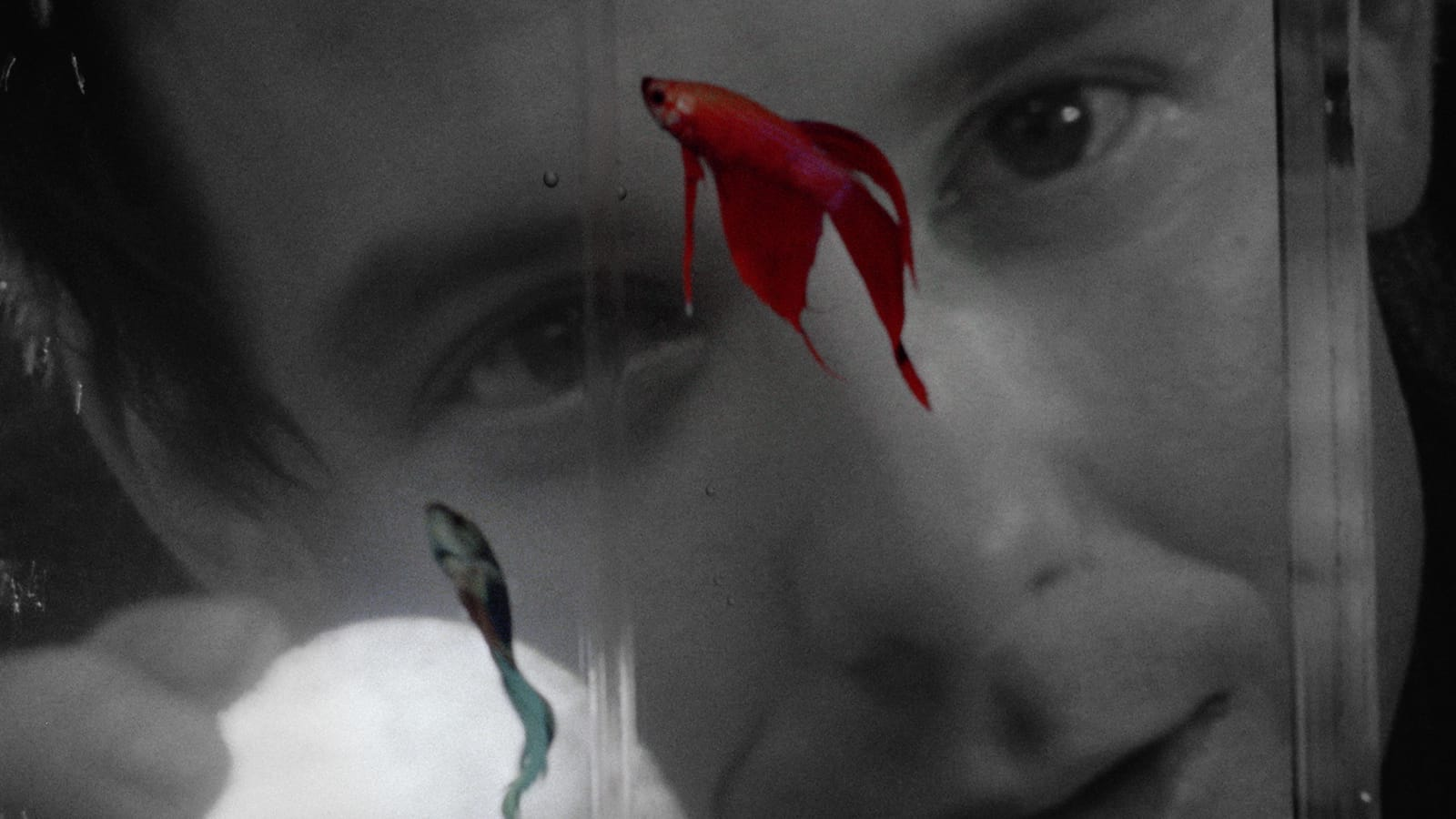
“What the fuck do the Greeks have to do with anything, huh?” Rumble Fish is filled with characters trying to figure things like that out, to decipher but not express or to express but not decipher their own relationship to the cosmos, to history, to the void. Coppola isn’t above telegraphing this by superimposing heightened, ghostly faces over their embodied forms, or having the characters appear out of the ether as though wandering in from some other film. Or having characters converse with ghostly, iridescent, shimmering reflections of their friends in the sign of a store, as though warped by the very visions they imitate. Or lines like “they try to kill themselves fighting their own reflection”, as the two brothers look at fish in an aquarium, the sole objects in the film that are brightly colored, embodiments of the youths’ roiling inner conflict nonetheless trapped drifting in a watery flow that feels like freedom but might just be a prison, or vice-versa. They envision, but they may not really see. One of the two, we are reminded, can’t even see the colors. Things, we are told, “meant something back then,” and Coppola has no issue making sure we know how unsure they are about these things when they say them.
Still, if the film is trapped in its own past, you can feel its tendrils going forward too, either in the Coen’s ice-cold Blood Simple or their red-hot Raising Arizona, or David Lynch’s own evocations of fractured American dreaming Blue Velvet and Wild at Heart (again, the presence of Cage in Rumble Fish, not to mention Dennis Hopper as the crestfallen father of the two central characters, helps the association), or Jim Jarmusch’s Down by Law (which also stars Tom Waits, who plays a barkeeper here who acts like a ghost who used to haunt the place, but now just hangs out there). These films form an ‘80s undercurrents, the melody of the decade thinking about and counter-weaving itself. Like a number of these films, the desert looms in Rumble Fish. We get nearly every set-up imaginable of characters walking down a lost road of the maybe-damned, the sort of road in Tulsa that might lead to Hollywood or simply around in a perpetual circle. The characters are just trying not to end up like Wile E. Coyote chasing the Roadrunner, believing they are trying on new toys that just leave them right back where they started. Maybe Coppola, here aware that the insatiable urge for breathless originality may simply mask how creatively unoriginal we all can be, is worried about this too.
We are all haunted by Hollywood, by imagery, by mediating influences, by desires rented and worn, the film suggests. The question is whether it worries about this, or if it recognizes in the failure to escape the iconography a kind of comfort, a kind of ramshackle coffee-house of shared influences and icons. In the final scene, the film pans across a long line of watchers and viewers, brought together by thwarted possibility and fatalistic yearning for a man who, like Coppola, went to California, but got lost on the way and never found the sea of solitude he sought. In the film, the man came back to Tulsa, but, the film suggests, what is Tulsa anyway without so many Hollywood allusions and aspirations, so many saturated dreamscapes, so many sensations that flow between reality and dream? It is only in their final, tragic scene together that the two brothers finally find their audience, find the theater of life that Rusty James so desperately wants, elevating themselves to iconographic puppets in a post-modern montage. They are, and have been in, a limbo of their own doing, but also a collective home of borrowed styles for lost souls we’ve all always been making, one which spells certain doom and, perhaps, our only hope.
Score: 10/10
 The Long Take