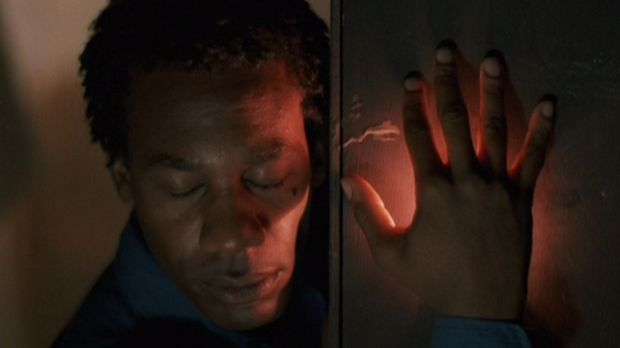
A shivering man (Joe Morton) lands on Ellis Island. We pan down to see that he is missing a foot. An interstellar fugitive from a chain gang, to use a metaphor the film will draw on later, the man is lost and lonely but also strangely filled with potential. When he bends down to take care of the wound, there’s a new foot there, albeit with three toes. Cinematographer Ernest R. Dickerson, in his second film after his student film with Spike Lee Joe’s Bed-Stuy Barbership: We Cut Heads (and before a lucrative further decade with Lee) shoots Morton with a gorgeous, crepuscular glow that weaves an inextricably cinematic spell, an iridescent halo seeming to illuminate him. The film offers a play of light and shadow that invites us in but allows Morton to remain somewhat obscure and impenetrable to us, even as the film will go on to meditate on the ability of this wayward traveler to vibrate with the world around him, to connect more deeply than we may be able to and in spite of the odds being stacked against him. Already, within minutes, we have an enigma that is far deeper than any superficial narrative mystery to be successively doled out in pieces by the filmmakers: what does it mean to find connection within and via alienation? As the film unfurls, filmmaker John Sayles conjures and concocts a whimsical meditation on cosmic loneliness that becomes an exploration of local togetherness.
If the film literalizes African American alien status in the United States, however, it also offers a fecund, sideways portrait of the Harlem community as a deeply lived-in collectivity, a village voice rather than a monotone. Loosely, we follow Morton’s character, named Brother in the credits, around Harlem as we and he interact with various figures who, we come to realize, are not really any less alien to the world than he. Brother from Another Planet is at its liveliest whenever it enters a bar that seems perpetually occupied by the same few people. One young black man speaks of Morton’s apparent “internal malfunctions” as he, himself, is cannily surrounded by malfunctioning arcade games. The characters speak with casual ease, one remarking that Morton looks like a “fugitive from a chain gang,” and another two getting in a tiff – more a meander than an argument – on “young bloods (who) got no sense of history,” who have “African sounding name … think they’re in touch with the past.” This is not a monolith but a deeply felt, albeit loving, collective conflict, one which Brother – who cannot speak but seems to loosely understand English – is adjacent to, but not at odds with.
Contrast this with John Sayles and David Strathairn, who play two interplanetary slave catchers and move with a robotic curiosity, like sharks out of water, but with single-minded intent, coursing through a world that never really connect with. When they enter the bar for the first time, Sayles shoots them backlit by a blinding white light, their faces obscured but without any of the loving ambivalence and mystery afforded to Morton’s outline in the opening. When they leave, Sayles remarks “we’ll be back” the same year Schwarzenegger did. The only time they show genuine glee is when they play with an astronaut toy on a kitchen table, a miniature parody of their own illusion of freedom. Later on, a white police officer, who clearly himself feels ostracized by the Harlem community, will ingratiate himself to Brother, claiming that if you “put on a uniform, it’s not like you hand in your card as a human being.” Morton can’t respond, but an earlier scene where a police officer chasing him is visually dissected into a collection of signifiers – a badge, a gun, a cap – a canny dissection of overdetermined recognition of danger, tells us all we need to know about what he might say.
When the store manager of a video game arcade that briefly employs our nameless protagonist makes a racist remark about his Mexican worker, that they do a “good day’s work” but have “no sense of time,” the film’s own rhythms, mercurial and playful, suggest how limited this understanding of time – punctual, universal, teleological – may be. In the way he is hyper-tensed but laid-back, always moving but always resting, always nervously on the path to somewhere but not precisely in a hurry to get anywhere, Morton’s Brother seems to embody a different concept of time (shades of Ralph Ellison’s Invisible Man, also as in Brother’s ability to tinker with machines). When a young woman wants to play an arcade game, she expounds on her ability to get “totally inside their time,” to vibrate with the game’s tempo in order to win. She doesn’t quite feel like she inhabits the same rhythm as the rest of the world, as though she exists in a world where everyone is “going slow-motion,” except her. Morton’s character obliges her, manipulating the game with his hand so that it plays at warp-speed, offering her the feeling of “slow motion, everything else zipping fast,” a technological communion that Sayles shoots as an erotic intercourse. When the aforementioned owner of the game parlor plants a pathetic kiss on machines that he can only mobilize for money, we realize just how genuinely sensual and considerate an empath Morton’s character is.
So is Sayles, after a fashion, finding humanity and love in the machinery of cinema. When two other white guys from Indiana show up to the bar, presumably in town for a business conference of some sort, they remark “communication, that’s what it’s all about,” but they can only seem to project their own desire to be black to Morton (“I wanted to be Ernie Banks, it never really dawned on me that he was black”) who neither asked for it nor needs it. Morton’s opacity becomes a canvas for them to express themselves, an attempt at community that is really, merely, a white longing for black desire, a way in which the machinery of America courts racial fixations in many registers. Another white woman tries to bond with Brother by claiming that there are “white slaves” in the middle east (“it’s a whole other planet” over there), overlooking the historical specificity of black slavery in the U.S. and the Caribbean, even as she won’t go back down south (where she’s from) now that she herself has a black child. It’s as though she feels like she too could be a slave in order to bond with him, an exquisite moment of ambivalent working-class association that exposes both the possibility of interracial connection and the thornier politics submerged just slightly beneath.
The whole film is alive with these micro-textures, the kind of lived-in, receptive energy that only a nominally slow-going, slice-of-life parable can offer. In one of the film’s sharpest bits near the end, momentary community arises out of skillful manipulation of the ironies of the very machinery they all inhabit. We’ve already, much earlier, watched a black woman turned away from a government office because she always lacks one piece of paper, but a later moment turns this portrait of institutional malfunction into a collective weapon as the two alien hunters confront American bureaucracy and are turned away, machine mobilized against machine. The interstices of oppression become an odd, momentary sense of relief, even though the film knows this is no liberation.
By the film’s end, Sayles and Dickerson give body to this undercurrent of possibility by fashioning a community of aliens living within the machine, a swarm of under-dwellers who chase away the alien hunters, a city of unknowns who are somewhat known to each other. Harlem used to be “the end of line” – as in, the place to be, the place to stay, to not want to leave – in the old days, remarks one older black character, insisting on the vibrancy and vitality of the space, a kind of perpetual motion machine you didn’t need or want to get off. A friend in the bar cheekily responds “I don’t see anybody here going nowhere,” ironically foregrounding the sad but oddly human and loving comfort of a place that is, perhaps, not what it was, but still filled with love and care and potentia. A quiet kinesis, another, dimmer variety of illumination, a softer but no less potent vibration. The kind that seeps from one scene to the next when a film isn’t quite so invested in stringing us along a narrative, the kind that develops on a Harlem film-set filled with passionate and skillful communicators mobilizing the machinery of cinema to a different rhythm. The kind that binds a film.
Score: 9/10
 The Long Take