
The famous opening of Federico Fellini’s 8 ½ visualizes auteurism – the notion that a director is an Olympian artist singularly responsible for their film – as a psychic and cosmic trap, a road to nowhere as everyone around watches you suffocate. They’re immobile, unhelpful figures in a dreamlike haze trapped in the Gorgon’s glare. Of course, as the film finally reminds us, if Medusa is a metaphor for the world’s horrors (as Siegfried Krakauer famously notes in his 1960 text Theory of Film, just a few years before Fellini’s film) and art is Perseus’s shield allowing us to glimpse the horror and move beyond it. But Fellini insists that art itself can also immobilize. In 8 ½, it is the director himself who won’t let the world and its people move. They can’t help him because he isn’t receptive to their energies. That the film itself amounts to both a validation and an excoriation of its own inability to heed those energies is, depending on your view, its central failing or its greatest success. 8 ½ is a masterful work, no doubt, but it’s also a grand-standing testament to artistic mastery as a form of artistic limitation. Personal responses may vary.
The auteur in question is Guido Anselmi (Marcelo Mastroianni), who we meet in the middle of a bout of director’s block on a film that has already had a rocket-ship of money poured into it, but has no screenplay. Guido is both an aspirational portrait of a director as ringmaster and channeler of the world’s energies and a tacit admission of guilt on Fellini’s part. He remains too caught up in his own ego to, as it were, release, too lost in his thoughts to let the film really feel. It takes a certain amount of chutzpah to make us spend 140 minutes, and to stake your directorial reputation, on an elaborate metaphor for erectile dysfunction.
All the while, Guido wanders and wonders and drinks and laments. His wife Luisa (Anouk Aimee) arrives on set, but he finds himself shuttling between various women, including his star Claudia (Claudia Cardinale), playing a thinly-sketched Ideal Woman, and his mistress Carla (Sandra Milo), not to mention many women who have come and gone in his past. The only one he has any real spark with is Rossella (Rossella Falk), Luisa’s friend and a pin prick into Guido’s cushion. Guido often fantasizes about mastering them all, but Fellini’s film is a study in how cinema itself – perhaps his tool for controlling and shaping the women how he wants, for avoiding those intangibles of interpersonal relationship he wishes weren’t there – simply won’t let him wall himself off in fantasies of authoritarian dominance. The camera often tries to hold on Guido in an odd shot length, not quite a close-up but too tight for a mid-shot. Other individuals enter and leave the frame constantly, an opaque portrait of a masterful individual becoming a startling impression of controlled chaos. A beautiful collectivity of relations that Guido refuses to admit inevitably percolate around him, catalyzed by his own failures to appreciate them.
Fellini’s most cinematic flourishes are, tellingly, those which most readily invite the command the film wrestles against. When Guido imagines himself as the maestro of a harem that includes the film’s entire cast of women, Fellini stages a wry and deeply Freudian set-piece that seems to roll up a dozen or a hundred mid-century equations between psychological mastery and cinema, artistic blockage as imaginative and sexual paralysis, into a simultaneous acknowledgement and self-parodic emission that cheerily mocks the whole logic to begin with. Earlier, Fellini turns a would-be business meeting into a sauna of the soul. While we search for an answer, Fellini turns the bathhouse into an elliptical dance of non-spaces and funhouse corridors we peer around but somehow not into. A door arises at one point for a clandestine meeting, but Fellini leaves us behind. The moment, the film seems to suggest, could only offer less than the conclusion it invites. Instead, we’re invited to explore, to revel in the exploratory aria Fellini concocts that revises and remakes the bathhouse, that defamiliarizes it, that salvages art and may save the world even in spite of its perhaps myopic vision of personal directorial ability. 8 ½ asks us to not, as it were, lose the fog for the sky. The mist and the smoke of the bathhouse matter more than the director’s high-minded vision or the meeting he is there to attend.
At the end of the famous opening with Guido suffocating, he flies into the air on a balloon, evoking a personal desire to transcend the contours of the social, an individual variation of the panoptic historical vision nearly achieved in the balloon flight in Tarkovsky’s Andrei Rublev. The opening is cryptic, but it never feels like an example of what Manny Farber once called “white elephant art,” that art that substitutes prepackaged, grand, easy-to-spot, ready-for-serving meaning for genuine affective curiosity and exploratory ambivalence, that curates rather than questions. While Farber called this superior, inquisitive, gadfly-like cinema “termite art” and codes it as capable of exploring the modest and the molecular because it eschews the immense and the enormous, 8 ½ finds the termite in the white elephant, turning baroque, gargantuan spaces into constellations of overflowing possibilities. It ponders the space between mastery and resonance, controlling and conjuring. It discovers the minor in the major.
8 ½ is, to be absolutely clear, a visionary film, one that warps and weaves reality into arias of the soul and incantations of the spirit. By this point, Fellini was a long way from neorealism, pressing ever toward the carnivalesque sensibility he’d been tinkering with since his earliest works. Having gotten his start in the industry during the heyday of Italian neorealism, Fellini’s earlier films celebrate wayward, struggling collectives of vagabonds and momentary friends who just so happen to have a camera trained on them. By 1960’s La Dolce Vita, Fellini’s cinema had grown outsized and self-critical (arguably self-importantly so, to the minds of many), much as Michelangelo Antonioni was acknowledging cinema’s alienation from reality and using this alienation to refract a critical eye back onto that reality, exposing everyday life’s inability to deal with itself.
Fellini’s film is certainly fully enclosed in itself, for better or worse. It’d be easy to criticize it as a cinematic Ouroboros, eating its own tail. Truth be told, Fellini has never risen to the ranks of Antonioni, Dreyer, Tarkovsky, or Bergman in my personal estimation. However, to my tastes, 8 ½ uses its failings to peer beyond itself, to recognize and recast its own analytical limits, in ways that are genuinely rare in the cinematic world. At several points, Guido is framed as an opaque shadow halo-ed with a shock of bright light, an outline indicating a simultaneous void and an inviting, perhaps dangerous, presence. He is both revealed and obscured, casting light on – or being cast upon by – many people, energies, moments, and places that shape him but which he wishes to obfuscate. Elsewhere, the film’s famously over-exposed backgrounds reduce the outside world to so much emptiness, a blank vista closed off by an artist whose world is hopelessly hermetic.
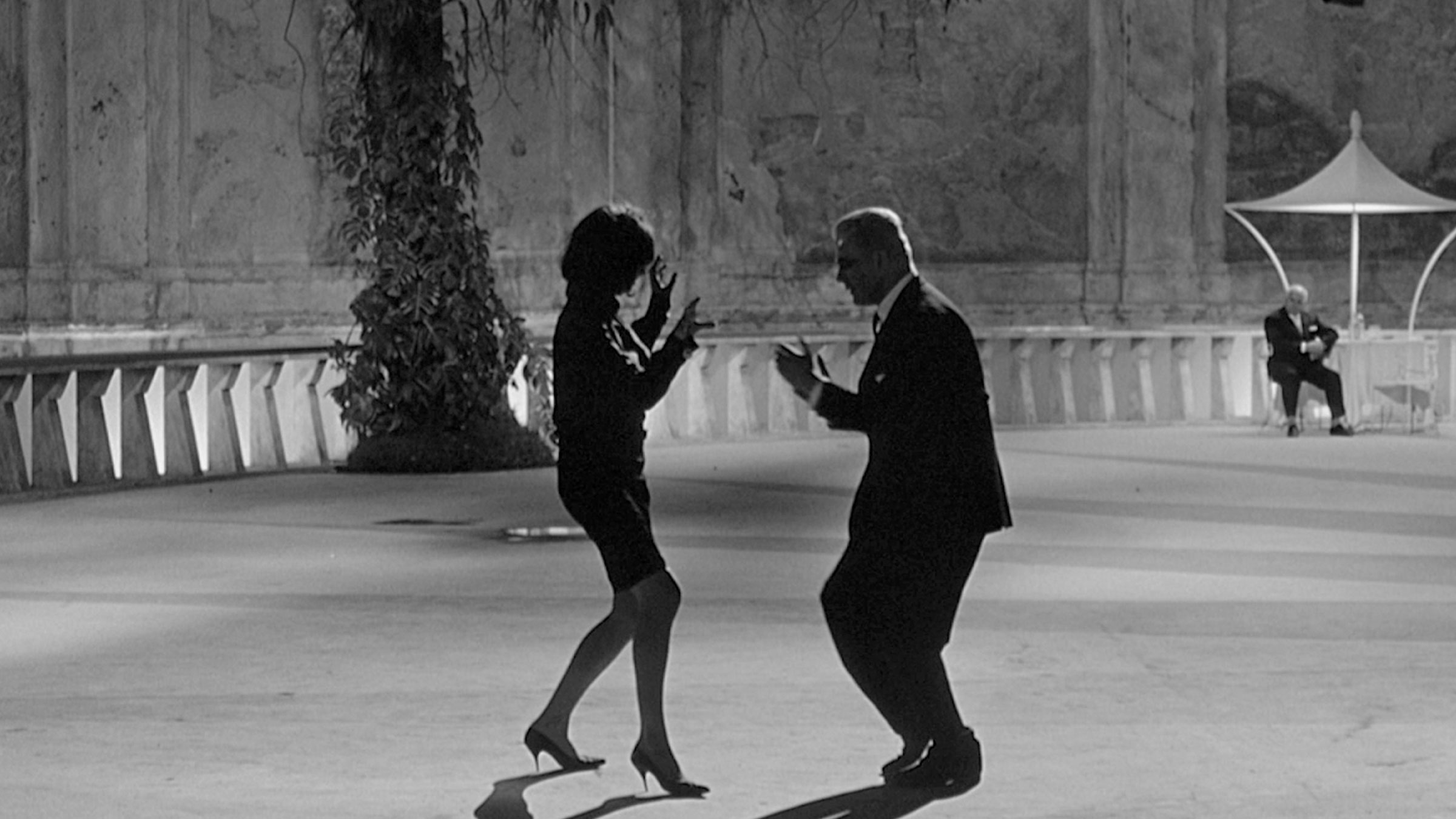
The film responds to its own pent-up energy by staging its finale at a gigantic phallus. While the gigantic and certainly very costly wooden scaffolding of a rocket ship – which, we see, was always going to have a mere picture of a spaceship superimposed onto it – figures early on as a marker of the director’s impotence, the set finally becomes a stage for a different sort of blast-off. Nearly giving up, the premature conclusion of the film shoot figured as an ambivalent replacement for a literal shot to the head, Fellini finds an angel, not unlike Chaplin and Bergman before him, in the form of a performer who returns to celebrate the performance of everyday life. In the finale, Fellini finally gives in to the carnivalesque atmosphere of chaos he has invited but shunned. Everyone returns, Fellini staging a glorious crescendo of human activity that genuinely approaches the carnivalesque spirit his films often gesture toward. The energies the film wants to abscond with, perhaps through the sheer force of its efforts to limit them, simply refuse to be controlled.
In the end, it’s not the film but the crew, and the camaraderie, and the energy, and the sensation that matters. Evoking Italian neorealism’s vision of a collective world of cinematic passers-by, where every turn of the camera might find a story worthy of visualizing, Fellini tips his hat to the glories of inescapable togetherness, a vision of art as a gathering-ground, a means of appreciating, bringing-together, and casting new light on the fluctuating matter of the world. Finally, a young boy who may be a memory of Guido and may be an actor portraying him – but, really, how much does it matter? – gets the last shot, a circus light cast on him from off-screen, but certainly Guido. Cinema can be a damned dictatorial thing, 8 ½ admits, but cinematic democracy wins out in the end.
Score: 10/10
 The Long Take