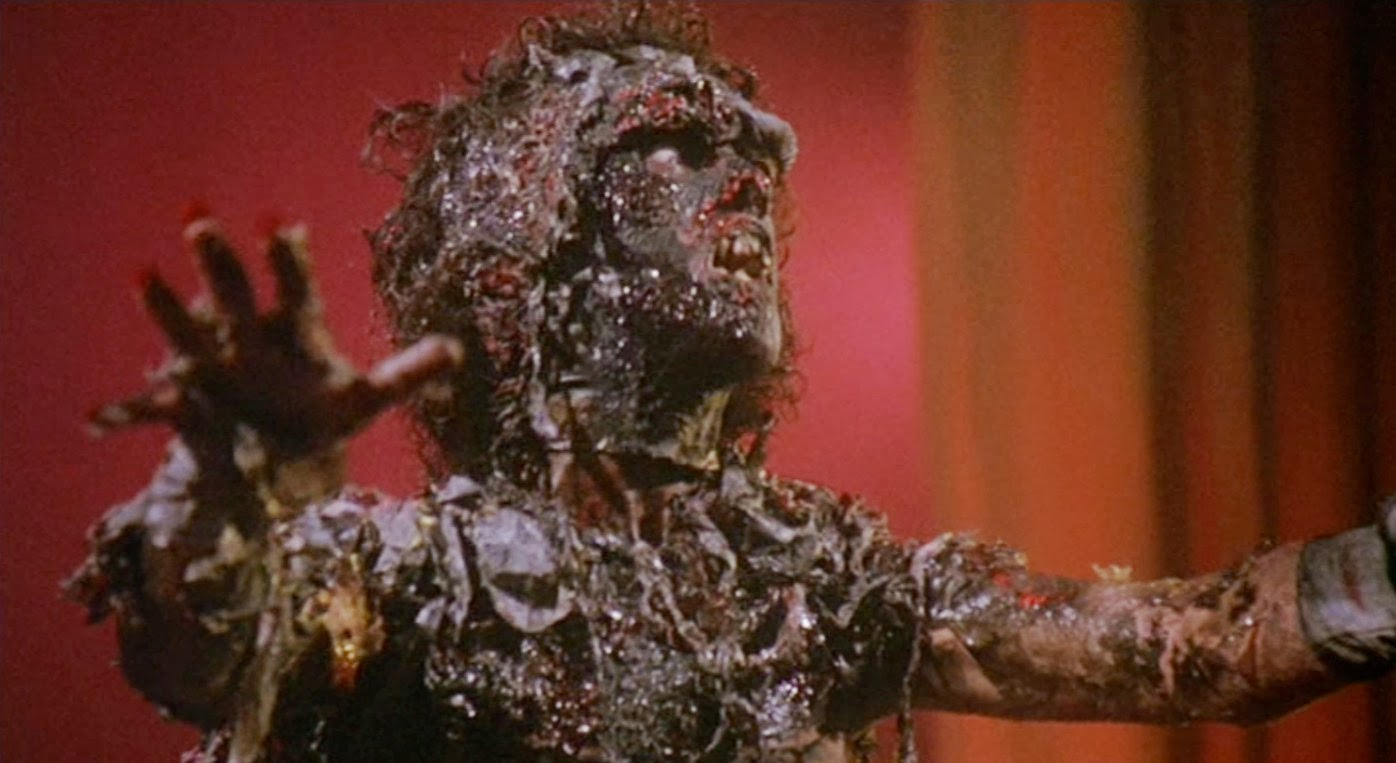
Hello Mary Lou: Prom Night II is a thoroughly slantwise sequel. Rather than honoring its predecessor, it merrily runs amok with it. Insofar, that is, as it is interested in the first Prom Night at all. That 1980 film was a first-generation slasher film, released when the genre was not so much figuring itself out as already dying a premature death in the womb. Creatively speaking, at least. Slasher films would continue to thrive in the box office for several years, but the genre was commercially on the way out by 1987, when this sequel was released. While many slasher films were still being released every year, horror cinema was on its way to the grave for the first half of the 1990s, before a revival closer to the turn of the century. Prom Night II treats the slasher era’s wilderness years as a real wilderness, living out a creative hunger to survive just by attempting anything at all. It is liberated, after a fashion, by the genre’s own demise, as though the relief of recognizing its own poor box office prospects allowed it to explore its own inner urges without apprehension.
Which isn’t to say that the film doesn’t have its finger on the pulse. Hello Mary Lou joins John Carpenter’s 1983 killer car picture Christine in excoriating its decade’s obsession with the 1950s, manifesting the Reagan era’s fetishistic fixation on its forebears as a literal possession by a dormant specter. That said, the film’s visual and sonic cues are hardly limited to, or even primarily defined by, ‘50s cues. If this film has a closer aesthetic analogue, it’s Kenneth Anger’s gleefully perverse explosions of mid-century teenage iconography. Although shorn of Anger’s wry recognition of mid-century American fascism, Hello Mary Lou similarly recognizes the paradox of turning to one’s ancestors for a portrait of youth and rebellion. And it similarly plays critique with a frisky grin rather than a moral scold.
Like Anger, director Bruce Pittman revels in the fetishistic and lustful excesses of idol worship, but he understands the idolatry intrinsic to cinema itself, reveling in the medium’s capacity to lovingly fondle an object in the hopes of genuinely exploring it and casting it in new light. The aftermath of the initial prologue kill, a 1950s-set revenge gone out of control, is refracted across several disconnected close-ups: we hold on a suddenly aware face, a piece of lost jewelry, and a closed briefcase of memories panning out to a lonely skull on the floor. The closed casket suggests a lost past constantly being claimed as property by children of the 1980s. When we cut to the film’s then-present thirty years later, we pan up to a looming school and then into a pastel ingenue’s room including a child’s rocking horse as a teenage girl looks at images of herself in the mirror. It could pass for a misty memory of Douglas Sirk or an Elvis picture, but the film already seems to be turning less to the 1950s than conjuring the spirit of French poetic realism in its bravura associations and nimble orientation toward assembling scenes and photographing objects for their suggestive value rather than their accepted or everyday associations.
The teenage girl, by the way, is Vicki Carpenter (Wendy Lyon), an innocent suburbanite who speaks in ‘50s rhythms long before she is possessed by the spirit of Mary Lou Maloney (Lisa Schrage), the girl who was accidentally killed in the prologue when her boyfriend Bill Nordham (Steve Atkinson in the prologue, Michael Ironside in the main film, and now principal of the high school) played a prank on her, never to be caught. Unlike Vicki, Mary Lou was entirely in control of her own sexuality, aware of what she wanted up to and including sex with other men who were decidedly not her date Bill. Her spirit trapped in a dusty case locked in the high school’s out-of-the-way spaces, she takes advantage of her release to inhabit Vicki and wreak havoc on the school’s upcoming prom.
Much as the film itself wreaks havoc with its own innocent iconography. The bedroom rocking-horse, a marker of youthful innocence that is also perhaps a parody of the urge to escape into the wilderness, metastasizes into a murderous force as Vicki’s blanket violently enfolds her, wrapping her in an outfit that turns domesticity and comfort into bandages to rival the Bride of Frankenstein or a corset worthy of Maria’s in Metropolis, a trap that is also unleashing of a different, more volatile inner-self. Vicki’s mirror, meanwhile, seems to want to suck Vicki into an alternate dimension, no longer mimicking the present but transmuting it, casting the decade’s dormant demons back to her darkly. Elsewhere, a volleyball net turns into a spider web, a barrier becoming a tangled liminal zone. Like the mirror, it is a border designed to keep people in their places turned into a porous vortex of uncertainty. A chalkboard will later turn into a pool, a blank canvas for creativity and knowledge into an engulfing abyss.
Some of these gestures directly descend from the likes of Jean Cocteau’s The Blood of a Poet (1932) and Maya Deren’s Meshes of the Afternoon (1943), the later famously figuring a deathly specter with a mirror-face as a metaphor for a person’s inimitable ability to haunt themselves. Those exploratory classics pulled and prodded at cinema, experimenting with its ability not to index reality’s surfaces but to limn its poetic crevices through artificial technique. In this light, Hello Mary Lou’s mirrors also reflect the dark mirror of reality that is cinema itself, exploding with an appreciation for film’s ability to refract rather than reflect the energies dormant within us. The first “present-day” kill is a cruel smorgasbord of billowing fabric and flaring particles, a music video dipped in the River Styx. When it ends, we see the setting restage itself to “normal” as the cracked jewel of the tiara returns to place via an obvious reverse-footage shot. The world has been violently distorted and returned to its ostensible sanity, a gambit central to the cinematic experience writ-large.
That reverse motion, the sense of things going backward when they shouldn’t, is mirrored in the film’s meditations on nostalgia, the sense of ostensible progress covering up the shadow of an undigested past. In this light, the film’s wonderful blackboard scene, where Vicki is sucked up into the classroom’s writing surface to be spit out as Mary Lou, is both deeply surprising in theory and thoroughly obvious in fact. What else have we been watching but a surrealist collage, a figuration of the past as a literal specter inhabiting the present, defamiliarizing it from ourselves. And what, then, is cinema, and horror cinema in particular, but a mirror of reality revealed as an ambivalent portal to an unclarified past that we assume we can look at or write on, but which we may be unprepared to deal with the consequences of? Prom Night II asks that we look with mischievous malevolence.
Score: 7.5/10
 The Long Take