
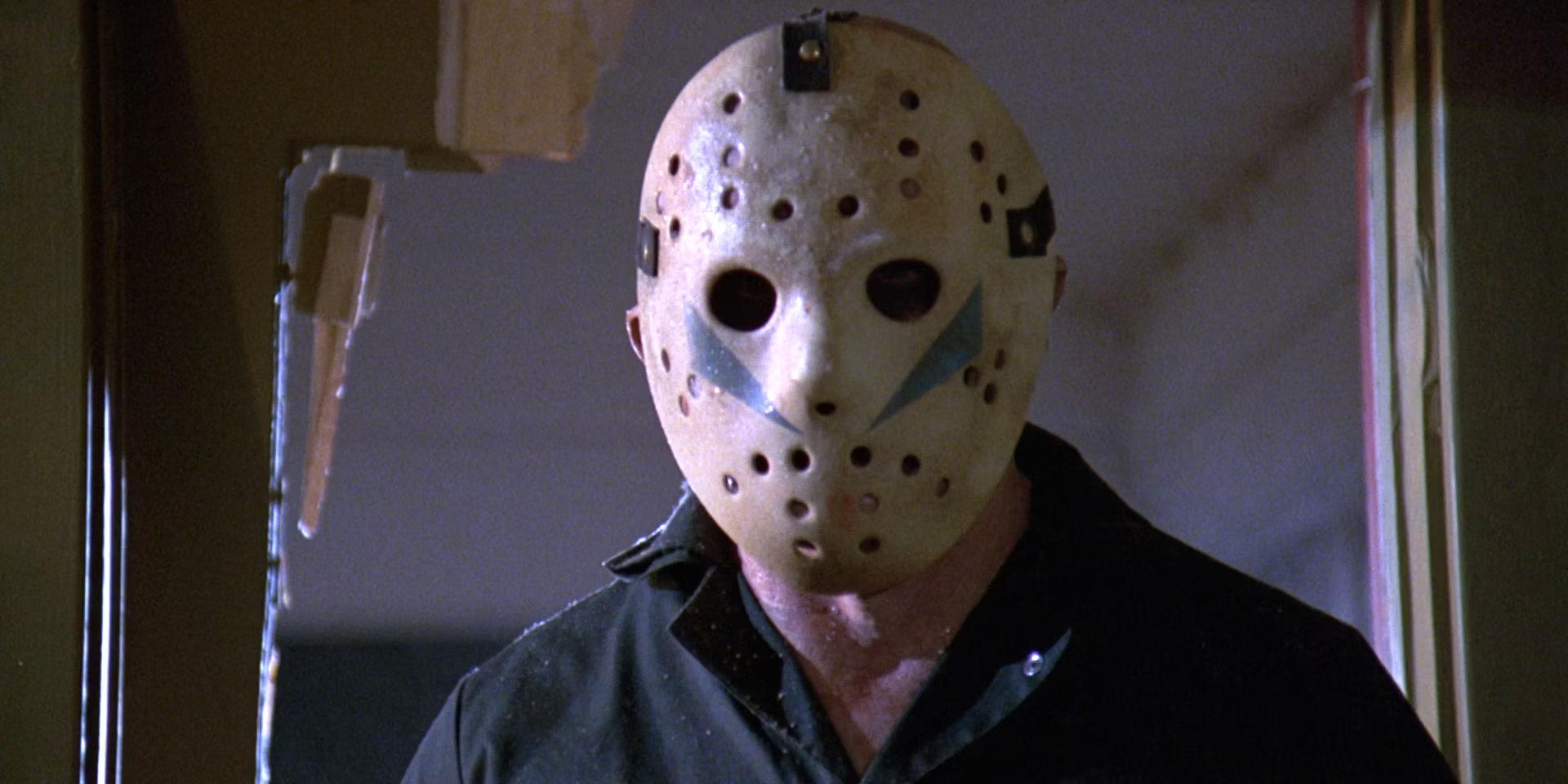
Having formally killed its Hockey-mask-clad central protagonist, Friday the 13th Part V: A New Beginning had nowhere to go but sideways. With the nominal franchise tetralogy concluded, but without the courage to shift away from the machete-wielding killer, the producers of Friday the 13th Part V took the cheapest possible route they could find. Rather than shifting to an entirely different story, a la Halloween III, or evolving the killer to include new emotional registers and shades of hate, a la Nightmare II, Friday Part V simply puts a new guy in a new hockey mask. His identity is technically a mystery but also entirely irrelevant and, famously, barely revealed in the moment of his ostensible, blink-and-you’ll-miss-it revelation. That may seem like a failure on the film’s part, but it also, oddly, recalls the spirit of a famous Edmund Wilson article called “Who Cares Who Killed Roger Ackroyd?” Focusing on an arbitrary narrative mystery asks the film to reduce itself to our conventional standards for judging cinematic quality. Does the identity of this killer matter? Could it? What does it say about us that we would want it to in such an empty film to begin with? Those conventional standards are fine if the film in question wants them, but Friday the 13th Part V is up to something, hacking its narrative to such tatters with Jason’s machete that it barely even registers as a film at all. Why can’t we search elsewhere for meaning?
This Friday looks not to the goal but the sidelines. The most revealing scene of the film, for me, involves two greaseball types who grace us with their presence for the duration of one scene, wandering in from one stretch of highway to another. Where they came from, and to where they are going, is entirely opaque, except that they clearly came from, and are trying to get back to, whatever other vision of existence they wandered in from. Why, whilst starting his stalled car, does one of them lapse into a crazed, chaotic whirlwind of a spoken-song consisting of various iterations of “come on everybody, it ain’t starting” as his car won’t turn on? And to what end? Because it privately pleases himself to sing? Because it is part of his character’s imagined backstory he invented in his head for his minute of screentime? Is this just who this character is, or this actor? Why doesn’t Jason kill him a minute earlier? Does he simply wish to watch this pencil sketch of a human for his own pleasure? What is going on in Jason’s mind? What was the director thinking?
Confronted with the abyss, the mind can only reel. By this point, Friday the 13th Part V has become a home for wayward cinematic souls, a kind of cinematic River Styx shuffling characters from other movies to and from the afterlife, with Jason as Charon. These two greasers die, and then we move on to new characters who show up for a scene or two, having fun with themselves before they are dismissed to the land of the dead. This is cinematic limbo.
Broadly, this is how Friday the 13th Part V proceeds, rushing headstrong between characters that are somehow both completely undefined and oddly particular and felt-through. New couplets constantly appear, primed for the killing but also ready to give us an odd glimpse into the human psyche for all of 90 seconds. It’s a cinematic mosaic. That none of these characters really matter in a narrative sense, or that they couldn’t sustain any relationship to them outside of the few minutes each is on screen, is both entirely true and certainly beyond the point. If Friday the 13th Part V is a void of content, it responds by turning cinema itself into a black hole.
I certainly wouldn’t be the first to suggest that it may be because the creative heads didn’t really care that the film seems almost liberated, freed for the characters to do whatever they want, however they want, and for the film to observe existence’s strangeness, to bask in the instabilities of whoever happens to be on screen as they exist in non-directed fashion, wandering through a minute of footage before dying. This is a film blissfully free of a screenplay. There’s no direction here, no organizing metaphors or clever conceits, no real attempt to guide our vision. For whatever reason, Friday V fulfills Andre Bazin’s old mantras about the documentary camera and the non-judgmental, open-minded frame. This is a perverse form of neo-realist cinema, a view of a world otherwise where a theater troop of the damned is simply free to be themselves.
Yet, if realist, Friday V also achieves itself through the heart of artifice. This is, more than it could ever know, animated by similar impulses as many older strains of avant-garde cinema, grasping for a deeper truth beyond the confines of seeming reality. This Friday is also deeply surrealist, deviously so because the surrealism is purely a matter of subcutaneous form, not manifest narrative. While the later Jason Goes To Hell would literalize the liquid logic of this franchise by recasting Jason as a demonic force that shifts between bodies, Part 5 simply performs this liquidity in its shambolic cinematic looseness. Unlike Goes to Hell, it provides no explanation for its madness, never reducing the delirium latching onto the screen to a mere narrative conceit. When the first kill happens, it is shockingly, breathtakingly, unmotivated – almost like the film itself has snapped – and when the final killer is revealed, the film dispassionately scans over it without really marking the moment. That it is a character we’ve only seen for a few seconds of screen time before is just the icing on the cake. The suggestion seems to be that it doesn’t really matter who, after all, is the killer in this film. Something is stalking between them, some force beyond any one of them. (Recall that this series was influenced by Bava’s A Bay of Blood, which is animated by a similar sense of worldly decay.) It could be anybody, and it might as well be. The film itself needed a new killer, a new hockey mask, so it infected one, and brought the world into itself for the fun.
Score: We Are Not Worthy/10
 The Long Take