
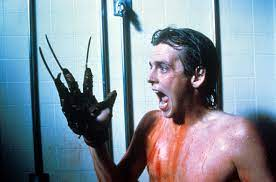
A Nightmare on Elm Street II: Freddy’s Revenge is a strange film to watch retroactively. It clearly isn’t yet fully aware of the expected texture of a Nightmare on Elm Street film because the weight of expectations hadn’t yet fully set in. But it’s also more liberated to follow its own energies, to treat the first film as a possibility to explore rather than a canvas to recreate on a larger, more absurdist scale, as the later films in this franchise did for better or worse. While Nightmare was a blinding light of cosmic terror, and the successive films would double-down on this formula to terribly successful (III) and just plain terrible (Freddy’s Dead) ends, the first sequel is a different creature all together. Queer in more ways than one, the film’s self-evident sexual subtext is all the more extraordinarily disarming because of how lurid and tortured it all is, like a film that hasn’t so much theorized its subject as felt it in its loins. Like its subject, this film is so unsure of itself and its structure that it seems to unleash energies it cannot quite explain or control. It is inverting formulas that it didn’t even yet know existed, partially lashing out at its forebears with a desire to be different and partially, simply, just not caring.
To its credit, if sex is typically associated with moral judgement or parental anxiety in slasher cinema, Jack Sholder’s film clearly fames the problem as a lack of climax. This film in no way believes, even as a product of unthinking corporate osmosis, that teenagers should not have sex, nor that they should be subjected to immediate death if they wish to. This Nightmare self-evidently believes that sexual frustration of all stripes is the culprit, and that identifying and being true to one’s even unrecognized sexual desires is an unambiguous good. “Subtext” is the word that is often brandied about in discussions on this Nightmare, but this is really only because the film is generally more interested in disturbing and trespassing on its own territory than making sense of anything in particular, and because it plays by the ruleset of its own id rather than developing any particular argument. There isn’t a “text” here to work with, just many stray feelings and sensations vying to be made manifest, repressed and latent urges in need of being rendered on the surface. For a mid-‘80s horror film, this is no simple thing. This is the feel of a film either not quite sure what it wants to say or so sure that it starts to drip off the screen. That, of course, makes it a more worthwhile film in more ways than one. That the film achieves this through a mostly nonsensical metaphor is either a feature or a bug, and no reviewer can determine that for you.
The subject of this metaphor is Jesse Walsh (Mark Patton), a closeted gay teen who doesn’t even necessarily see himself as queer, who is rapidly becoming a puppet for one Frederick Kreuger (Robert Englund), who turns Jesse’s teenage desire and liminal uncertainty into a literal portal between worlds from which to haunt the living. Jesse is alleviated only by his friend Lisa Webber (Kim Myers), although what, precisely, their relationship is remains opaque throughout the film, and not only because it nominally trades in whether or not Jesse wants to enter into a relationship with her, and whether he is heterosexual, but also because he, for all apparent purposes, has only just moved to town, and yet they act like long-term friends. The certified bully storyline with Ron Grady (Robert Rusler), meanwhile, stops almost as soon as it begins, shifting between genuine antagonism and friendly ribbing in the space of a single line. The characters, who they are, what they want, what defines them, all seem to change even within single scenes.
This isn’t a twist or anything, not a Hollywood reminder that we’ve been reading things all wrong, that the film is too clever for us and was secretly working under our noses. Rather, it’s as though the film itself is torn, is being pushed by some cosmic horror force to fulfill a series of archetypes it has no interest in buying into or spending time on. Lisa isn’t really a girlfriend, and Ron isn’t really a bully. They’re barely coagulated forces in teenage bodies, shifting emotional registers that vary depending on what the film needs in the moment. By any traditional register, this is simply bas screenwriting, but it gives this Nightmare a twitchy, unhinged vibe that is genuinely unique in the series, even if it makes for a much more inconsistent film than either of its bookends.
Score: I mean, come on?/10
 The Long Take