
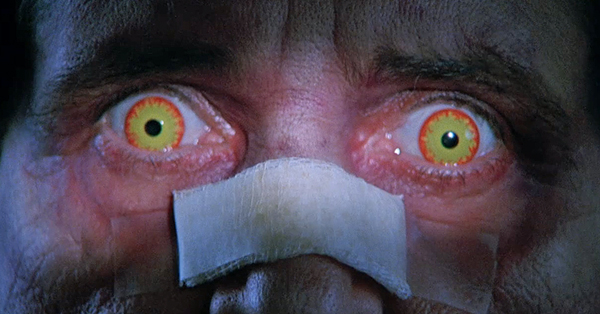
Lord save The Exorcist III. While never succumbing to the dark depths that suffered John Boorman’s delirious 1977 The Exorcist II: The Heretic, writer-director William Peter Blatty’s 1990 attempt to salvage his beloved franchise from the mismanagement of other voices fared little better among critics when it is released. While William Friedkin’s adaptation of Blatty’s original book The Exorcist was a truly epochal zeitgeist hit in 1973, a refraction of social backlash to the free-wheeling ‘60s, Blatty was always uncomfortable with Friedkin’s quintessentially ‘70s quasi-nihilistic hopelessness. Following Stephen King’s own famous critique of Stanley Kubrick’s demonically beautiful adaptation of The Shining, Blatty took it upon himself to reframe the film franchise that was surely his greatest claim to fame, turning it into what he’d always intended it to be: a beacon of light in the face of unmitigated evil in the world. Suffice it to say, the resulting film wasn’t what audiences or critics, deeply enmeshed in post-Reagan era cynicism, wanted.
Friedkin’s original The Exorcist, despite barely resembling his other films, is unmistakably the work of a man who was fascinated with psychic, social, and cosmic forces assaulting porous bureaucracies and systems in crisis. The deeply disturbed Exorcist II: The Heretic, a cosmic fracas of late ‘70s entropy as the decade tried to figure out what it was up to, was simply a psychic force all itself, not a film with something to say but an energy with designs on our consciousnesses. While Friedkin was a skeptic and Boorman a crank, Blatty was a zealot. Gone from The Exorcist III are Friedkin’s muscular mercuriality and Boorman’s psychedelic maelstrom. Instead, Blatty creates a comparatively unambiguous, deeply sober examination of the potential for evil in the world, a film that could for all intents and purposes be called simplistic, even “square.” But this is certainly not for lack of trying. The Exorcist III was released during a remarkably unimpressive few years for the horror genre, and, whatever else it does or does not do, it is certainly the work of someone seething to unleash something upon the world.
Why, precisely, it fails is perhaps the more interesting question. The simple answer all comes down to Blatty’s self-evident inexperience as a director. As someone who had clearly spent a great deal of time around cinema but had only one prior directing credit, the deliriously unhinged but passionately strange 1980 film The Ninth Configuration, Blatty was both deeply invested in The Exorcist and highly frustrated that it had become a portable pastiche of secular cosmology and exploitation cinema in the hands of other directors. Blatty’s idolatry is both The Exorcist III’s blessing and its curse, creating a film that is both a great explosion of cinematic potential and a cosmic mass of imaginative material desperately searching for a coherent form of expression Blatty may not have had in him.
But we’re getting ahead of ourselves here. The Exorcist III is unmistakably Blatty’s child, an angelic attempt to burn away the sacrilegious demon babies his book had unleashed, a genuine rebirth that sought to smite the earlier films. While The Heretic followed the MacNeil family, the subject of the original film’s demonic possession, Blatty returns to the men of crisis who originally interested him (and interested Friedkin in the first film, to be fair), to the institutions of power – the police and the church – and the dark forces and spectral presences that they can’t fully recognize but must keep at bay. The worldview is unmistakably traditionalist – there’s no two ways around it – but there’s a psychic honesty to the film’s portrait of everyday cogs in a machine confronting energies and truths they have only the most tenuous grasps on.
Specifically, The Exorcist III returns to police detective Lt. William Kinderman (George C. Scott), a side-character in the original film, the detective as stalwart man of rationalist reason. While Kinderman was haunted by his experience 15 years earlier in the original The Exorcist, Blatty’s second sequel somewhat deviously implies that the case that existentially torments him most is a decidedly more human affair, the 15-year-old Gemini Killer case. When new killings bearing unmistakable similarities to the original Gemini Killer (the details of the killings were falsified in the press to weed out false confessions) including the murder of his dear friend Father Joseph Dyer (Ed Flanders), Kinderman’s history comes flooding back to him. And the dam breaks when he goes to talk to a man who confesses to the new crimes – despite being locked in a psychic ward room all day and night – and who just so happens to look like one Damien Karras (Jason Miller), who had killed himself while inhabited by the body of the demonic Pazuzu at the end of the original Exorcist. Except, at other times, the man appears not as Karras but as James Venamum (Brad Dourif), who, Dr. Temple (Scott Wilson) informs us, wandered into the psychic ward 15 years before, around the time of the Gemini Killer’s spree and of Karras’s death.
These are the bones of a man in crisis thriller, a story about the need to acknowledge cosmic evil and confront it with faith. It’s also the canvas for a film that we must have a little faith in. There’s a lot of symbolism afoot, and we’re introduced to the themes via a slamming door and a Jesus statue that weeps blood within the film’s first minute. This is a talkative text – the product of Blatty’s career as a screenwriter – both verbally and visually. Blatty lays it on thick, and with gusto. For all its faults, The Exorcist III feels cinematically distinct, toying with and teasing out relations between the physical and the spiritual via numerous associative matches and graphic cuts, between people and statues, people and people, statues and statues, forces and flows. Especially given the film’s reticence to actually show its kills – all of which occur offscreen and, in the film’s best and most famous moment, can be deviously intimated in the space of a very literal cut – it is deeply surprising how conspicuously directed the film is, how bravura it gets with its imagery. Characters seem to warp around space, as though they can’t move themselves and the film has to push them, a physical rendering of their own mental solidification and inability to leap into different mental spheres. Space itself often seems discontinuous, as though the film is trying to move them, to jar them into new realization, to shatter their consciousness so it might be rebuilt, as though they are cogs in Blatty’s iconographic montage.
It’s easy to write all this overblown style and thematic ponderousness – this is a film that talks and talks about death without ever truly showing us a death – off as a failing on the film’s part, but it creates the sensation of a film that itself seems frightened of its own images, as though the film is actually scared of what it is envisioning. The film registers, and laments, psychic forces outside the contours of its vision, even as it demands we confront them regardless. The curious mixture of maximalism and minimalism reinforces the film’s themes of having to acknowledge that which we cannot possibly wrap our heads around. Even in the opening moments, with its near-baroque atmosphere and flashy cinematography that nonetheless show us almost nothing, the film registers intimations of dark and demonic entities haunting it, sensations the film itself can only hint at via totems that glimpse an awful truth beyond the visual. Cinema itself, the film queries, may not be pious enough – may not believe enough – to actually see what hides right in front of its lens.
In this sense, regardless of their very real differences, Blatty does recapture Friedkin’s penchant for maniacal forces at work in the world, even if Blatty is ultimately more hopeful about our capacity to engage them with something like a quiet heroism. This is a disturbed film, its twitchy, jittery editing rhythms alternating between nervous, hesitant longueurs – as though afraid that cutting might be the space in which the devil envelops the film – and hectic shifts in texture – as though leaping ahead, afraid to look behind its shoulder. In one particularly disconcerting moment, we cut from Kinderman frustrated in a conversation with Dr. Temple and then to Kinderman leaving a room, which we quickly surmise is a different room entirely, and that he is now walking into a third room. Space and time seen to warp and weave around the characters, to torment them and enfold into their traumas. That is, when the film isn’t suggesting that evil doesn’t even need to try. In perhaps the film’s signature moment, we watch an open corridor for minutes that feel like hours as hospital workers go about their graveyard shift. One of them will be killed seconds before the shot ends, but the final suggestion here is that it doesn’t really matter who or what kills or is killed. Evil stalks the halls in even the most mundane circumstance, and Blatty’s film shivers with disquiet at what hides behind even the most mundane exterior. Thus, the entangling of Karras and The Gemini Killer, and their mutual entanglement with the demonic. In the film’s finale, Kinderman speaks to horrors both real and imagined, a voice-piece for Blatty’s severe worldview, and a new convert in the somber and disturbed work that chronicles it. This certainly isn’t my worldview, but let no one say that Blatty hasn’t exorcised his demons.
Score: 7.5/10
 The Long Take