
I am making a New Year’s Resolution to return to blogging during the year 2024, starting with a slew of horror films in January to start the new year off on the dark side. But I had one or two holiday lumps of coal that just couldn’t wait until the calendar year switches over. Happy Holidays.
Christmas, an ostensible apotheosis of human togetherness, is also the apex of modernity’s hypocrisy and self-contradiction. While Christmas offers possibilities, it also implies assumptions and standards, and smuggles in judgement and failure. In addition to exacerbating consumerism, it metastasizes potentially possessive orientations toward compassion doled out in objects rather than genuine empathy. It is, as many have remarked, the loneliest time of year. While this isn’t a new observation, few films dissect these paradoxes as viciously and unapologetically as Lewis Jackson’s Christmas Evil. In the guise of an exploitation film – or because it is an exploitation film – it exploits the gap in our stated and performed values, scratching at it until it bleeds.
You know you’re in for something special almost immediately: Christmas Evil joins the wonderful club of films whose on-screen titles are different from their marketed titles. Christmas Evil’s in-credit title is You Better Watch Out, whose declarative claim suggests a moralistic missive which can’t quite match the blunt vagueness of Christmas Evil, perhaps the most straightforward title one could conjure for the narrative presented, but also the opaquest. “Christmas Evil” is almost totally unrevealing – it tells us next to nothing – yet it really tells us everything we need to know. It evokes the real feel of this film, a kind of brute poetry that puts in very little ostensible effort but radiates a kind of demonic sorrow. The vicious simplicity of the title anticipates a film that is both, minutely observed and deeply abstract, extremely simple and deceptively complex, a film that reveals more with every viewing, a gift that keeps on giving.
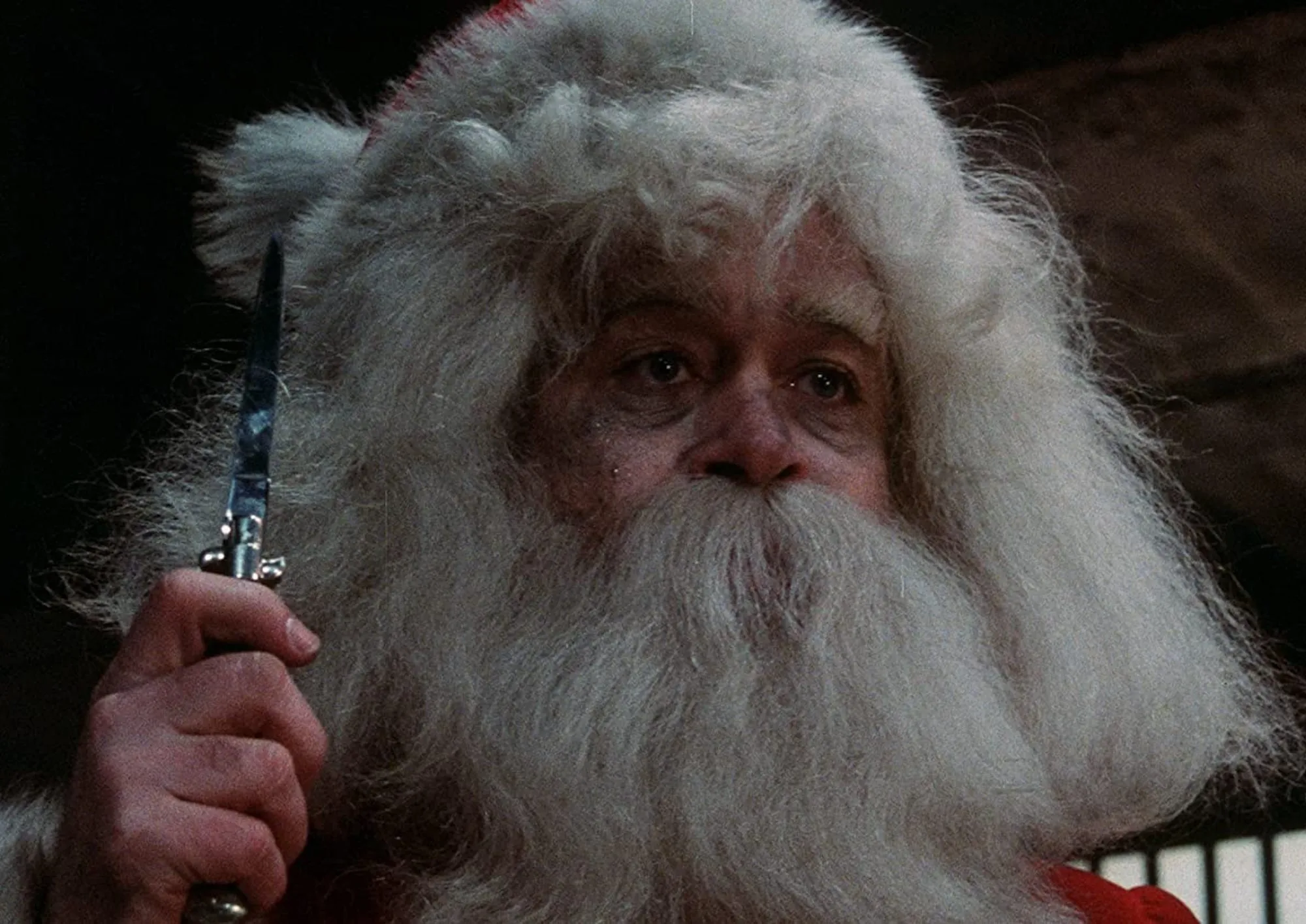
Christmas Evil begins with a particularly elusive, brittle variation of the old cliché of the killer’s childhood psychosexual trauma. When young child Harry waits for Santa one Christmas morning, he witnesses his mother making out with Santa Claus, presumably his father dressed in a costume, and a sudden shock of an edit informs us all we need to know about his inability to cope with the revelation. Yet the scene is reticent – it’s over in a couple minutes – and it ends with the most portentous opening-scene shattered glass snowglobe since Citizen Kane. While Citizen Kane spends two hours prodding and poking at the mystery of Charles Foster Kane – what broke the snowglobe of the soul? – by turning through the pages of his history, Christmas Evil settles on a seemingly simplistic but ultimately no less revealing conclusion within a thirty-year cut to the adult Harry: this man is broken, and something about society may have produced him.
While it is no Kane, Christmas Evil exhibits its own potency in its refusal to clarify the darkness at the heart of its central character. While most slashers provide a spark of trauma to provide a narrative basis for their killers, Christmas Evil is ultimately, like Kane, more of a character study, revealing itself to be a text about a character who was unable to reconcile themselves to a world that produces idealized images it can’t quite measure up to. The adult Harry (now played by Brandon Maggart) himself is an aporia and a void, a loner whose ambivalent relationship to the world isn’t signaled via Kane’s expressionistic, high-contrast shadows and bravura slanted angles but via the dingy, barely-held-together slovenliness of a ‘70s low-budget shiv to the gut.
Christmas Evil feels like a broken film, a tattered work trying to piece itself together via Linda Leeds’ and Corky O’Hara’s elliptical and associative editing rhythms. At one point, when the adult Harry runs away from a situation, he is abstracted into a shadow and a few footsteps across the city streets, a spectre in search of a human form. Several times, a truly malevolent sounding piano tune assaults the film, suggesting a demonic interference of stray energy or some strange transmission from a holiday id. When Harry hums a quietly haunting, minor-key rendition of “Santa Claus is Coming to Town,” it slowly metastasizes into a more malevolent tremor, within which we can hear and see Harry’s own bodily tremblings bubbling up, as though some cosmic disturbance is shivering him to pieces. He will go on to unleash that trauma by fashioning himself a savior for the masses, a reclaimer of holiday spirit. In his dark actions, Christmas Evil also fashions a diabolical cracked-mirror image of the Christian sacrifice which ostensibly forms the moral center of the origins of the holiday itself. The film becomes a dark meditation on sacrifice and the notion of absolution itself.
Throughout, Lewis Gordon has a canny eye for the everyday uncertainties and quiet disturbance of the holiday season. A perverse corporate ad celebrating commercialism on television is an obvious, relatively easy mark for the screenplay’s scabrous treatment and mockery, but the nominally more authentic holiday parade Harry watches on TV looks just as alien, like a phalanx of skeletons in fascist unity. At an office holiday party, one fellow worker sounds like a robot, and the cinematography (by Ricardo Aronovich) routinely curdles the lustrous shine of metal toys into the grotesque. Harry’s domicile, meanwhile, is a mausoleum of cherished objects, potentially loved things that ultimately turn Harry into an automaton in what amounts to a human sized dollhouse. When Harry runs through the streets in the finale, Gordon produces a thoroughly demonic shot of the neighborhood space where the unholy glare of the holiday decorations lining the streets look uncannily like the torches his neighbors are now chasing him with. The neighborhoods of Anywhere, USA look like roads paved to hell itself.
All of this suggests that Christmas Evil doesn’t merely refract a broken psyche, but a disturbed world. While Harry spends the film silently staring at what he considers to be society’s failures through windows and into mirrors, when Harry watches his younger brother Philip (Jeffrey Demunn as an adult) – who doubted Santa’s reality as a child – it is Philip who looks at his wife Jackie (Dianne Hull) with leering intent. In another, lesser film, Harry would be a lazy after-image of Travis Bickle, but Christmas Evil uncannily recognizes that the its own more outré moments of outsider violence lie on a continuum with the more mundane, everyday authoritarianism that structures the domestic relationships that seem to be safer and more adjusted to society’s normal functioning. This dark view of the world isn’t a projection of Harry’s warped perspective so much as a particular, albeit strong, refraction of social forces Harry seems abnormally sensitive to and unable to find a more productive outlet for. The film suggests thatHarry is a dark interloper who scratches at the gap between moral vision and depressing reality, a schism that is impossible for him to maintain without unleashing a cosmic howl of rage.
Score: 8/10
 The Long Take