Monthly Archives: May 2016

Midnight Screenings: The Hitching Post

family-shadow-of-a-doubtShadow of a Doubt

It’s no coincidence that Shadow of a Doubt, although several films removed from Alfred Hitchcock’s American debut, was the first masterpiece of his thirty-year sabbatical from British filmmaking. Fine though they were, films like Rebecca – playing around in desecrated aristocratic spaces and cavorting in the hallowed regions of spectral Old Money sticking to you like bones – played to an American producer’s somewhat stilted view of a British director’s propriety. Those not in the know would be excused for assuming they were British productions anyway. But Shadow of a Doubt, the director’s favorite among his own films, is a noir-infested, corrosively polluted work of invasion and sabotage that found the director not only unearthing the world of everyday American suburbia, but taking his newly adopted home to task in the process. Continue reading
Un-Cannes-y Valley: Son of Saul and Timbuktu

son-of-saul-319114Son of Saul

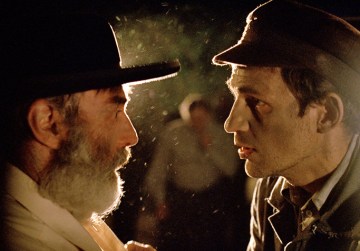
László Nemes’ Son of Saul is above all a treatise on cinematic minimalism, eschewing visual resplendence only as a way to belie how carefully modulated its visual command of its subject truly is. Tethering its audience to the face of main actor Géza Röhrig not as an anti-formalist gesture but as a haunting lament toward the unclassifiable nature of trauma, Son of Saul surreptitiously removes event to its periphery as a way to reveal that which can’t be formally, objectively understood through any direct visual gesture. It is perhaps the film to most dexterously utilize the corporeal weight of the Holocaust as a case-study for the tangled spindles of memory and cinematic representation since Alain Resnais’ seminal Holocaust feature Night and Fog. In comparison to, say, Schindler’s List, Son of Saul defies any mass-scale anthropological interpretation as fundamentally incomplete. Even more than The Pianist, Nemes’ film recalibrates the Holocaust film so that any attempt to formally order it within a cinema frame – innately containing it and subjecting it to a sort of classifiable definition – is a whiff of historical wishful thinking. Continue reading

Un-Cannes-y Valley: Cosmopolis and Only God Forgives

cosmopolis-2Cosmopolis

David Cronenberg’s horror-show visual vernacular isn’t exactly the obvious lexicon for reimagining Don Delillo’s famously literary prose, but this gross, improbable collision of styles – a bewildering intersection between the maximal and the minimal – accrues a near-omnipotent surrealism over the course of Cosmopolis’ dead-by-day car-ride odyssey. Set primarily in the limo of a youthful billionaire (played with a sullen, zombie-like, quasi-ironic, and entirely fitting detachment by Robert Pattinson) during a car ride expedition to a hair-cuttery on the other end of New York, Cosmopolis morphs into a prismatic, unsettled excursion by its end that doubles as long-day-of-the-soul and a fantastical tryst with absurdity and the essential entropy of life. Continue reading