 I decided to write a regular Midnight Screening for Friday this week anyway, because I couldn’t resist the opportunity to immediately discuss Gun Crazy…
You are excused for thinking Gun Crazy was released in pre-Hays Code 1932, post-Hays Code 1968, or in Europe in 1950, the actual year of the film’s release. Sure, Gun Crazy isn’t brutally violent or pornographically sexual or anything. Director Joseph H. Lewis, an auteur among B-movie directors, relies on suggestion and implication more than overt expression, but all of this unstated terror and innuendo only makes the film naughtier and nastier. None of it hides the essential truth, revealed right in the film’s opening act when the main character’s older sister informs a judge that “something else about guns gets him, not killing”, that Gun Crazy is dripping with sexual metaphors and an indifferently Freudian, but nonetheless sharp and incisive, commentary on how violence and sexual gratification are intimately linked in modern American culture. Not exactly fair game for Hollywood in 1950, but then, that is the privilege of motion pictures produced on the cheap: they don’t have to appeal to a majority of Americans, and they can fly under the radar of “respect” by the brain and the heart and drive right into the gut. Continue reading
 “Actor turned writer/director” is a questionable phrase for a movie reviewer. Even more skeptical is the age-old “they’re good with actors” argument everyone trumpets when they fall overboard for the likes of Robert Redford upon directing a stately, dismally respectable, vacantly uninteresting prestige pic of the Capital-O Oscarbait demeanor. Sure, actors turned directors tend to have a certain camaraderie with their cast, but a good cast, a good performance, despite what seemingly every lazy reviewer in the world tells you, does not a good movie make.
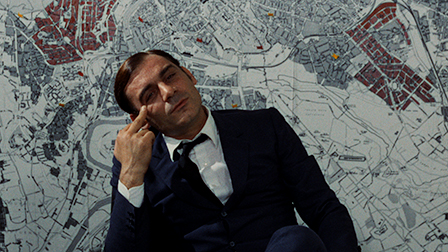 It is almost certainly the case that this is an uninformed generalization based on the nationalistic segmentations of modern society since the late 1700s, but Italians just seem to have the most fun making their films. Again, a generalization, but then the fact that nations have, like them or not, been constructed over the course of the modern era does in fact mean those nations, by virtue of government, economic, and social divisions, bear social differences in how groups of people like their art, and boy is it my impression that Italians like their art most furiously.
  Our two Midnight Screenings, both underappreciated “cult” films from the ’70s, come early this week. Enjoy!
  Robert Aldrich’s What Ever Happened to Baby Jane? lies perilously close to Sunset Blvd., so much so that the screenplay by Lukas Heller and the visual style by Robert Aldrich would be shameless repeats if they weren’t so rapturously evocative and explosively effective. You can call it whatever you want: a drug-addled fever dream variation on Sunset, a hysterical nightmare that Sunset had about itself, a corrosive purifying of Sunset so that all the relative cleanliness of the material had been washed away until only the abrasive sandpaper at the core remained. Ultimately, what saves What Ever Happened to Baby Jane? is not how it differentiates itself from Sunset, but how it rips into the Sunset aesthetic with such scabrous gusto and full-throated commitment that it exposes the horror cinema trappings of the chiaroscuro noir-speckled visuals and wonderfully garish vulture-like acting of Billy Wilder’s venerable 1950 film, the ultimate Hollywood work on the perils of Hollywood.
  Thrillers are so serious. Grimly, absurdly, stuffily serious from time to time, and, as a matter of interest, Costa-Gavras’ most famous film, 1969’s Z, is a mighty serious affair as well. But it is also a Costa-Gavras film, which means the seriousness is as macabre and sinisterly naughty as humanly possible. Right from the beginning, with an opening credits montage set in a government meeting where the camera cuts around and into the debate, the kaleidoscope of off-kilter, anti-continuity angles instigates the meeting, presenting it as a cohesive jungle of governmental nonsense and anti-sensible incoherence. What they are talking about almost doesn’t matter, and indeed, the point is that no one seems to care or have any idea why they are actually having this conversation. Costa-Gavras is cutting deep, but the scene plays like a demented carnival as well as a serious inquiry. I could not describe it in any way that meaningfully elucidates the humor as anything other than the driest variety, but the sheer dissonance of the shots and the edits, coming when we least expect them and giving us absolutely no sense of what is occurring before us, is brutally funny. Dry and abrasive, but cripplingly funny.
  Billy Wilder was the Hollywood cynic. We all know this. It wasn’t necessarily always the case (Some Like it Hot is one of the most delightfully buoyant screen comedies ever made, despite a dark edge). But he had it in him from the very beginning, and he kept it in him until the very end. If you want scabs though, and I mean pus-filled, oozing, inventing-colors-so-they-don’t-have-to-be-just-black-and-blue scabs, you have to stick with mid-period Wilder, who, with Sunset Boulevard, turned Hollywood against itself like a rabid dog unsure of its target and found that even this wasn’t enough. One year later, unfulfilled and still in need of making the nastiest Hollywood film yet made, he unleashed Ace in the Hole upon the world, and his vengeful edge, his sickly grotesque demeanor and love of exposing the least well-lit regions of human activity, absconded down the churlish rabbit hole.
  Edited
 Another little temporary series here. Nothing too fancy – mostly an excuse for me to catch up on some films I haven’t seen or haven’t seen in a while. We’ll be looking at three classical Hollywood filmmakers over time: Howard Hawks, John Ford, and Billy Wilder, visiting each once in the annus mirabilis of classical cinema, 1939, when they were all still (relatively) young, again in the late ’40s and early ’50s at the middle of their careers (and the middle of classical Hollywood’s career), and finally when things were waning for each director and for classical Hollywood in general in the early ’60s, before the new school American New Wave would wreck up the joint.
  The Long Take